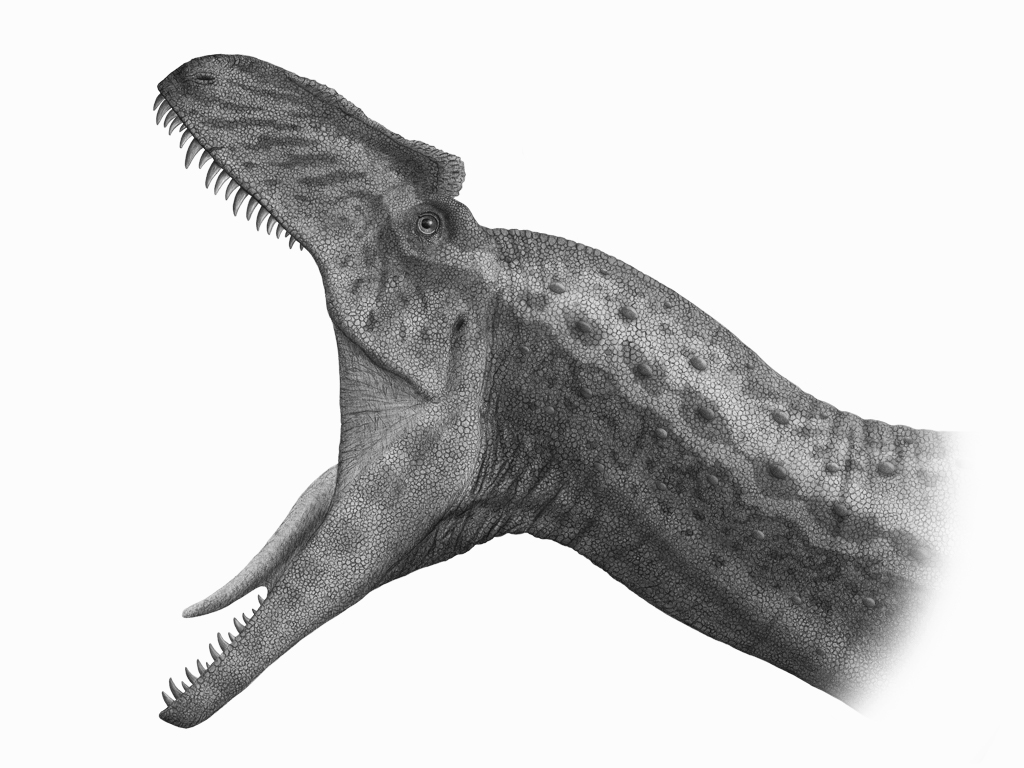
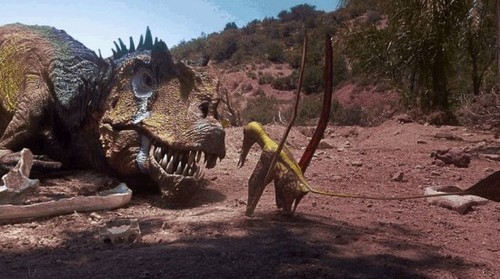
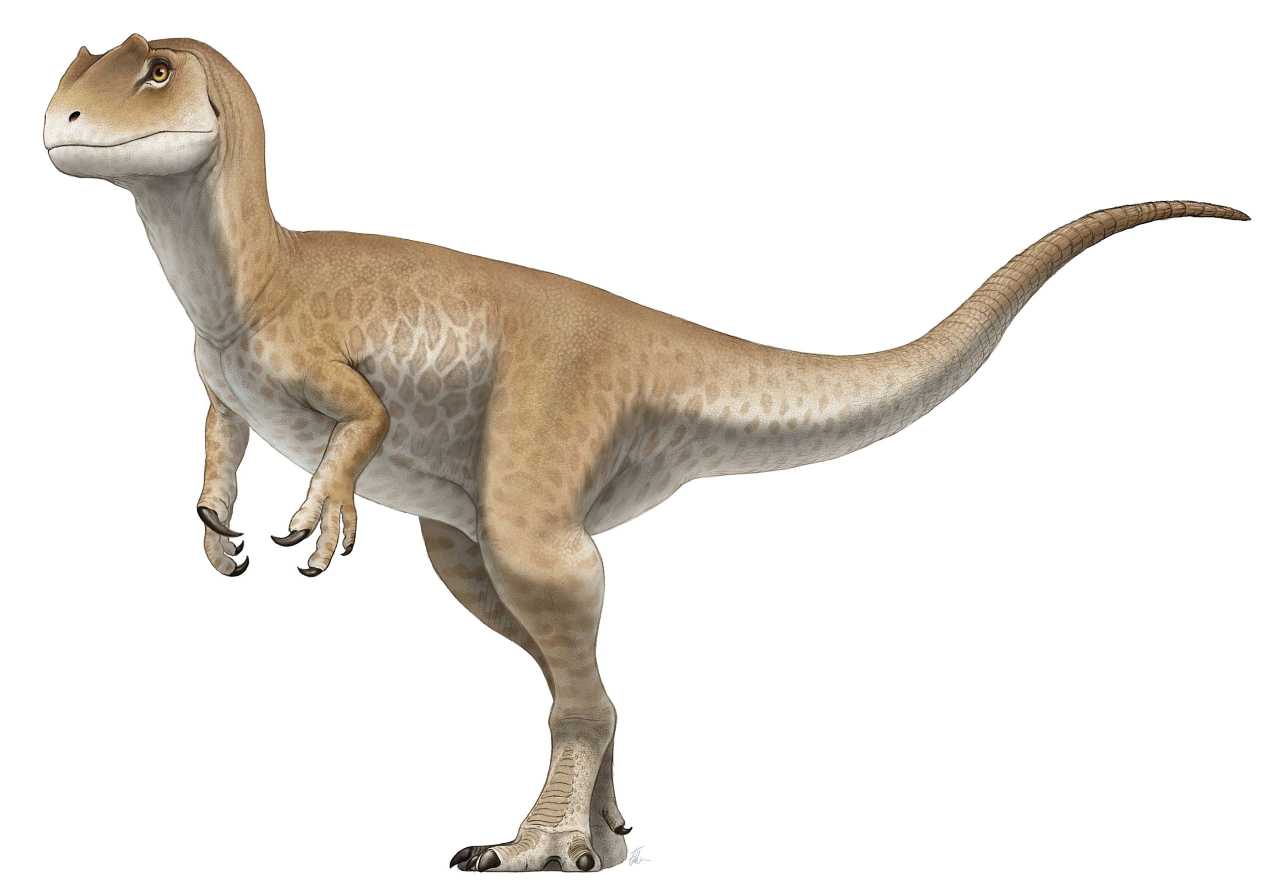
Allosaurus is by fair one of the most famous predatory dinosaurs, so much so that I’d rank it third behind T. rex and Velociraptor (perhaps in competition with Spinosaurus for that position, after Jurassic Park III,) and was one of the first well-known theropod dinosaurs, having been discovered even before T. rex. It lived between 155 and 150 million years ago in the Kimmeridgian to early Tithonian stages of the Late Jurassic period. It has fossils found in the USA (Morrison Formation), Portugal, and Tanzania, and is the most well represented large theropod ever, with many fossils found and a without-a-doubt reconstruction. It and T. rex represent the quintessential large theropod dinosaur in popular culture. It is the state fossil of Utah, and was in Arthur Conan Doyle’s novel/film The Lost World. Due to its fame, it has had many appearances in dinosaur documentaries: Walking with Dinosaurs, The Ballad of Big Al, When Dinosaurs Roamed America, Planet Dinosaur and Dinosaur Revolution all feature it. In short, we know a lot about it!
By Fred Wierum, CC BY-SA 4.0
Allosaurus is mainly known from, and originally discovered in, the Morrison Formation. The Morrison Formation is probably one of the most famous fossil discovery sites, with a vibrant dinosaur community, often considered comparable to the African savannah. Allosaurus lived in savannahs surrounded by forest, interspersed with rivers and lakes that supported many different types of dinosaurs for it to feast on – and Allosaurus would have definitely been one if, if not the, top predators. It was about 8.5 meters long, with some individuals about 9.7 meters long, or even 12.
By Steveoc 86, CC BY 2.5
The first fossil was found during the bone wars in North America, and only one species is considered valid (despite many being named to the genus over time, and many other genuses being renamed as Allosaurus. It was your all around typical theropod: long legs, short arms (not as short as T. rex though,) long tail for balance, and powerful jaws. These jaws would have been able to open up at an angle of about 92 degrees, and as such it served as a sort of axe jaw – slashing at prey over and over again until it bled out. It had small horns above its eyes that either could have served as weapons (unlikely,) to shield from the sun (more likely,) or to distinguish the species or for display (most likely.)
Allosaurus did have binocular vision, but only twenty degrees of it, making it important that Allosaurus’ prey stayed directly in front of it for Allosaurus to have any sort of depth perception of the prey. It had a brain similar to that of a crocodile, with a very large olfactory bulb, allowing Allosaurus to rely on a few well known smells such as that of carrion. It had very robust arms, which would have allowed it to grab on to prey or even mates during the mating process; this is interesting as almost all other large theropods had very weak forelimbs. The roof of its skull was fairly thin, which would have allowed for thermoregulation of the brain. Two of the most significant Allosaurus find are “Big Al” and “Big Al Two”, both found in Wyoming and both are fairly complete skeletons. Big Al was probably a subadult, with 19 broken or infected bones that probably contributed to its death. A major problem was a bone infection and trauma in its right foot that limited its movement; preventing its ability to hunt and therefore to heal. This indicated the exact difficult of life for Allosaurus, and how oftentimes their biggest enemies were each other – as depicted in The Ballad of Big Al (one of my favorite dino docs).
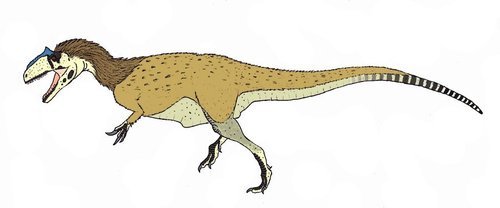
Allosaurus was the most common theropod in the Morrison Formation, living in flat floodplains and living in distinct wet and dry seasons. It lived along side the theropods Ceratosaurus, Ornitholestes, and Torvosaurus, and the sauropods Apatosaurus, Brachiosaurus, Camarasaurus, and Diplodocus, and the ornithischians Camptosaurus, Dryosaurus, and Stegosaurus. It was most commonly found with fossils of Apatosaurus, Camarasaurus, Diplodocus, and Stegosaurus. In the Portugal formations where Allosaurus was found have many similar species but a stronger marine influence, given its proximity to the coast; and lived there with Allosaurus, Ceratosaurus, Torvosaurus, Apatosaurus, Lusotitan, Camptosaurus, and Draconyx, the latter three filling similar niches as dinosaurs in the Morrison formation. Allosaurus coexisting with Ceratosaurus and Torvosaurus shows clear niche partitioning, with Ceratosaurus and Torvosaurus most active around waterways, forests and the underbrush; whereas Allosaurus would have preferred the dry floodplains and savannah. As it lived in a hot environment, and is known with scale impressions, it probably didn’t have feathers – though this hasn’t been ruled out completely, and a variety of reconstructions are shown here.
By Fred Wierum, CC BY-SA 4.0
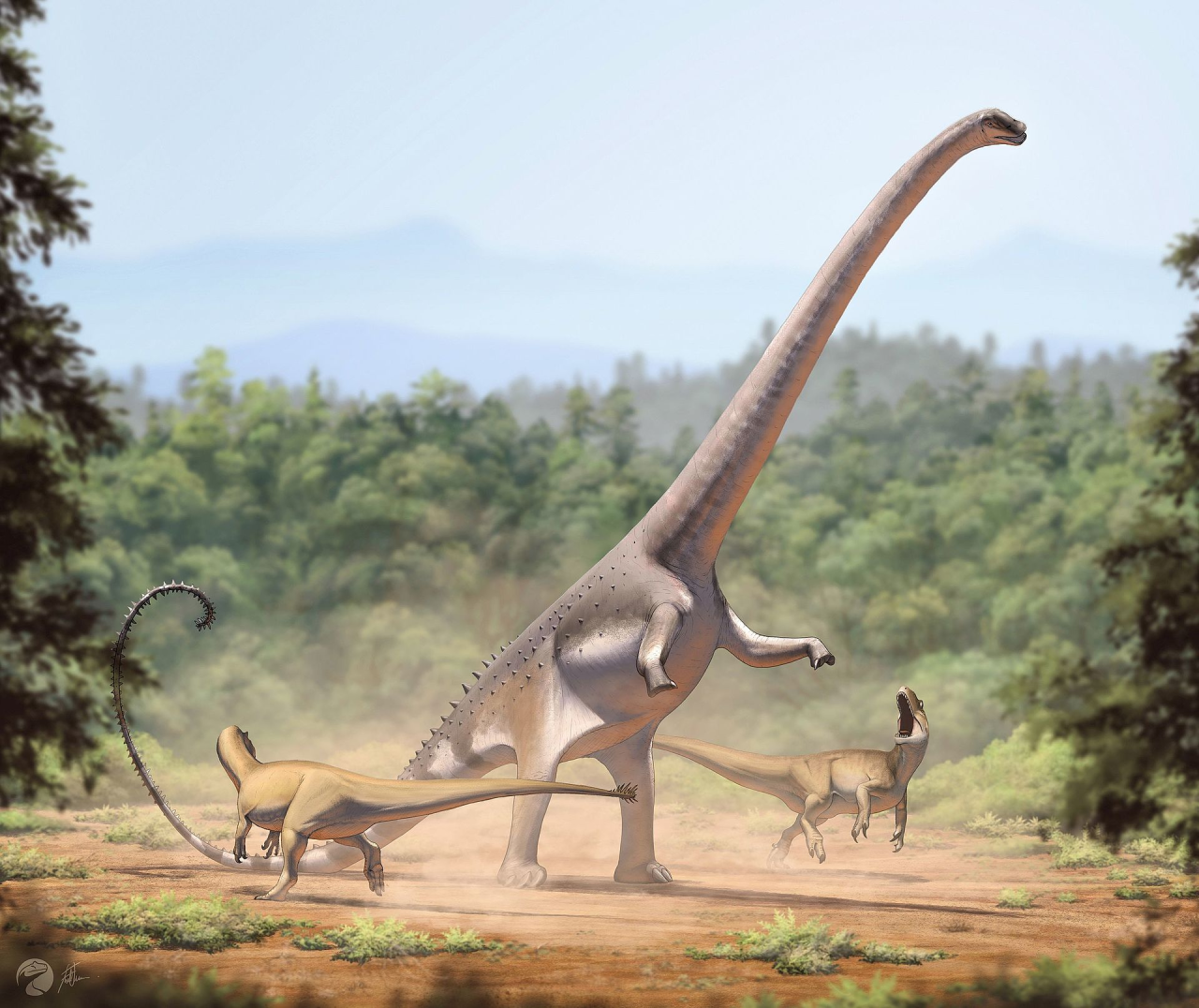
Allosaurus has been shown to stop bone deposition at 22 to 28 years, similar to other large theropods, and it stopped growing around age 15. Medullary bone tissue – a type of tissue found only in female birds laying eggs, since it gives calcium to egg shells – has been found in one Allosaurus individual, allowing for it characterization as an egg-laying female, or at least one that reached reproductive age. It has also been found that juveniles had longer hind legs than adults, suggesting that the younger Allosaurus were faster than the adults and probably chased their prey, where the adults would rely on ambush strategies. It is widely agreed that Allosaurus was an active predator, given evidence that it attacked Stegosaurus, and sauropods being their most likely candidates for prey and scavenging, giving scrapings on sauropod bones and teeth with their bones. It probably wasn’t a predator of fully grown sauropods unless it hunted in packs, which was probably likely in the case of juvenile Allosaurus. It had a strong jaw with a small biting force, using the saw-like jaw to slash on large prey, weakening the victim. Its top speed would have been about 30 to 55 kilometers (19 to 34 miles) per hour.
Juvenile by Fred Wierum, CC BY-SA 4.0
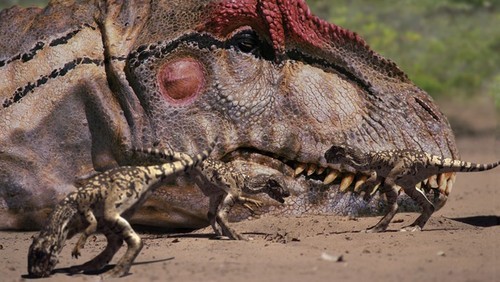
It has widely been hypothesized that Allosaurus cared for its young, given shed allosaur teeth and large prey animal bones chewed up that Allosaurus could bring back to their lairs. However, this is still under wide debate. Given the propensity for birds to care for their young no matter their size, and Allosaurus’ relatively close relationship to birds, I am inclined to think it did exhibit some parental care; it is also possible Allosaur chicks were feathered (and, yes, even adults.) It is also possible that most Allosaurus intraspecies interactions were aggressive; apart from hunting in packs it is possible that these were highly territorial animals. Many Allosaurus were found in the Cleveland-Lloyd site, indicating that it was a predator trap – a sinkhole or quicksand that trapped prey and predator alike. It is also possible that the large predator Saurophaganax was just a large individual or even species of Allosaurus. This was a vibrant, common, and important predator; with complex lifestyles and interactions: the quintessential theropod dinosaur.



 Plot Designing