Creative Writing Professor at a former college: Welcome to creative writing! By the way,
you will not write fantasy, ghost stories, pranormal, or science fiction
in this class, as this is a creative writing course.”
What the ever loving fuck is with “creative” writing professors who think that speculative fiction of any stripe ISN’T CREATIVE?
I still remember my own creative writing teacher telling me this because he saw the Terry Pratchett book on my desk and got this smug smirk on his face like “aha, gotcha”. He had the nerve to pick it up and call it “popularist fiction”, like somehow being popular and easily accessible made it less inherent in intellectual value.
I had it in my back pack because I did my final thesis on the evolution of mythology and folk tails into fantasy and sci-fi and the societal importance of telling stories (before anyone asks, no I don’t have it, I lost it when I moved continents), and I used Terry Pratchett because there wasn’t a single humanitarian issue the man did not touch on.
Which I told him. And then he kind of floundered and went “ah, well but, it’s…well I mean it’s not exactly high brow”, like neither the fuck was Shakespeare or Dickens you self-important turnip. Dickens was literally selling his stories by the chapter. He was the popular author of his time. Shakespeare was too, he fucking made up words and phrases all the time because the language he needed to express himself didn’t exist in the way he needed it too.
Intellectual elitism is nothing more than a hold over from class warfare and the belief that only certain people should get to be truly educated. And it needs to be smashed.
And God knows Shakespeare loved dick jokes more than he probably loved breathing.
i can’t believe I’m enough of a nerd to watch this whole thing in fascination when i’ve only ever played this track on the DS where i don’t think any of this is relevant
First of all, love is a joint experience between two persons — but the fact that it is a joint experience does not mean that it is a similar experience to the two people involved. There are the lover and the beloved, but these two come from different countries. Often the beloved is only a stimulus for all the stored-up love which had lain quiet within the lover for a long time hitherto. And somehow every lover knows this. He feels in his soul that his love is a solitary thing. He comes to know a new, strange loneliness and it is this knowledge which makes him suffer. So there is only one thing for the lover to do. He must house his love within himself as best he can; he must create for himself a whole new inward world — a world intense and strange, complete in himself. Let it be added here that this lover about whom we speak need not necessarily be a young man saving for a wedding ring — this lover can be man, woman, child, or indeed any human creature on this earth.
Now, the beloved can also be of any description. The most outlandish people can be the stimulus for love. A man may be a doddering great-grandfather and still love only a strange girl he saw in the streets of Cheehaw one afternoon two decades past. The preacher may love a fallen woman. The beloved may be treacherous, greasy-headed, and given to evil habits. Yes, and the lover may see this as clearly as anyone else — but that does not affect the evolution of his love one whit. A most mediocre person can be the object of a love which is wild, extravagant, and beautiful as the poison lilies of the swamp. A good man may be the stimulus for a love both violent and debased, or a jabbering madman may bring about in the soul of someone a tender and simple idyll. Therefore, the value and quality of any love is determined solely by the lover himself.
It is for this reason that most of us would rather love than be loved. Almost everyone wants to be the lover. And the curt truth is that, in a deep secret way, the state of being beloved is intolerable to many. The beloved fears and hates the lover, and with the best of reasons. For the lover is forever trying to strip bare his beloved. The lover craves any possible relation with the beloved, even if this experience can cause him only pain.
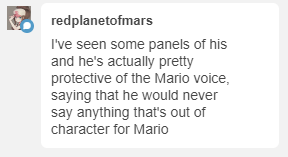
do you think charles martinet has ever said the word “Fuck” in his mario voice? not necessarily on the record of course but as like a gag at a party “hey charlie say ‘fuck’ like Mario” and he’d just do it
oh thank goodness
The “Go on Mario, say fuck” comic is canon
why would you need charles martinet to say fuck in the mario voice when he’s already said the most iconic quote in mario history
Probably the biggest complaint I have about the word “discourse” is that it conflates two concepts that used to be separate: wank and meta. The differences are important.
Meta was a discussion. It was meant as a jumping off point to look at a complex issue. It dignified its subjects by treating them with the maturity they deserved. It was reflective and enriched by multiple points of view. Whether serious or light-hearted, meta thrived on presenting evidence and discussing the impact of that information. Its purpose was to get everyone involved thinking more deeply about a topic, often including the OP.
Wank was wank. Whether it was ship wars or personal vendettas, wank was about in-fighting. It was ~ drama ~. It was there to start a fight it planned to win, and winning was its only goal. It was frequently superficial and careless in its impact, and it generally rested entirely on either false evidence or no evidence at all. It was the stuff that made gawking into a major fandom passtime, via fandom_wank and other resources.
This doesn’t mean there wasn’t poorly thought-out meta, or that no wank ever did something good. (Some wanks were very good at teaching everyone important lessons, like that you need to know what you’re doing in order to run a con, and not to harass actors.) It’s not about the tone, either – I’ve seen some very angry meta and some light-hearted wank bait.
The difference is entirely in approach. Meta frames itself as part of a dialogue and actively invites participation and alternate interpretations of the data. Wank declares itself the one true way and actively invites popcorn and/or everyone running for cover. Meta understands that there are multiple truths in terms of personal experience but that facts, such as they can be determined, are important as a base to work from. Wank is about what someone thinks should be the facts, in the face of all evidence to the contrary.
Prior to tumbl-hell, it was understood that feeding the trolls was a bad idea. When fans wanked, most others noped out. But now, with this new “discourse” term elevating ship wars to some sort of art form and dignifying arguments which we used to understand were full of baloney, people feel required to engage. Instead of pointing and laughing from a safe distance, we’re feeding the very worst trolls and giving them the power to convert others to trolldom and harass anyone who doesn’t conform to their wank-defined rules.
The thing is, we did this before. In the 90s. It sucked. The point of the term “wank” was to recognize the self-congratulatory nature of the (probably universally human) behavior, box it, and set it to one side. We couldn’t stop it from starting, but we could choose not to feed it. Now it’s out of the box again, and it has not improved with age, let me tell you. Phew.
So, petition to bring back both terms and drop “discourse” like a rotten potato. It’s not useful, because it conflates real conversations with standing in a room screaming with one’s fingers in one’s ears.
This reminded me of an article I read a couple of months ago that stuck with me. It was about talking to Trump supporters, and how the two approaches of either always blowing them off as racist idiots who can’t be reasoned with, or approaching every interaction as an earnest attempt to see their point of view and to introduce other perspectives, are not viable.
The thesis was that there are basically two types of conversations that can happen when we talk about ideas. Some people*, even if they hold views we find odious, base those views on perceived facts–those facts may be incomplete or erroneous, but they are operating in good faith in that they believe that facts matter and opinions should be somehow grounded in facts. Other people, even some who hold views we agree with, use opinions and facts interchangeably, as a way of making a point about identity and belonging. They will say that they believe what they understand their group to believe, and it doesn’t matter if that belief is an opinion, a fact, or a straight-up lie.
Someone who’s arguing in Style A might say, “Global warming is bunk; the last couple of winters have been the coldest I can remember.” What they mean is, “I have made a conclusion based on the facts immediately available to me.” They may not be curious enough, or educated enough, or have enough time on their hands to seek out additional facts upon which to base their conclusions, but there is a fact in there somewhere, and they care about it. Show that person a map charting average winter temperatures across the globe, and point out how a portion of North America (the portion where I and my imaginary interlocutor happen to live) is the only place that recorded lower temperatures than usual, and everywhere else on the planet was higher, and that person might reconsider, or at least conclude that they don’t understand the topic as well as they thought they did.
Someone arguing in Style B might say, “Global warming is bunk because environmental regulation hurts jobs.” What they mean is “People in my group believe that global warming doesn’t exist, and that environmental regulation takes away people’s jobs. The connection between these two statements is that they are both things that people in my group believe, about the same broad topic area.” This person does not care whether either of these statements is literally true. Either one can be used to justify or “prove” the other, but presenting evidence against one won’t weaken the speaker’s belief in the other–or even the first one, probably. Presented with facts that challenge their beliefs, this person will double down on those beliefs, because you aren’t having a conversation about what is true about the world; you’re having a conversation about what kind of person they are. And you, a stranger of the internet (or a co-worker around the water cooler, or a distant cousin at the family reunion) are not going to change their mind about what kind of person they are.
So the best approach is to gently engage with Person A (if you have the time, facts, and spoons to do so), but leave Person B alone. But the hard part is, you can’t always tell which type you’re dealing with. The only solution is to make the best call you can, based on the available evidence. If you make the wrong call, and get into an argument with someone using Style B, don’t beat yourself up over it, but be aware of the sunk cost fallacy–when you realize your mistake, just walk away.
The bolded point above is, I think, really important, because for those of us who have been socialized to Not Feed the Trolls, it’s really embarrassing to realize we’ve done just that. It’s tempting to keep hammering away, trying to either turn it into the Style A discussion you thought you were having, or at least score some points so you don’t look stupid. But there’s not really any point, unless you’re performing for an audience whose views you might change, or whose opinion of you is important to you.
So those are my thoughts about The Discourse, and they’re as relevant to fandom wank as they are to Srs Bzns.
(*I say “some people” here as a shorthand; of course, the same person may argue in Style A in some situations and Style B in others.)


 Plot Designing