Unrelated, but boy do I wish I were an anthropology major in college right about now so that I could write a bombing thesis on why doing the hokey pokey at Hurricane Florence in the hopes that she’ll turn herself around is a seemingly legitimate modernized attempt at animistic folk magic.
As an anthropology minor and psychology major I can absolutely assure you that it is. A large portion of magic particularly folk magic regarding weather and tragedy is about meaning making and reassurance. It drives humans up the walls to have no control over our environment and for bad things to happen for no tangible reason because we’re normally so good at controlling our world and noticing cause and effect. Because of this even just joking about “Let’s blast “Florence at the Machine at Hurricane Florence until it leaves” makes us feel better because it gives us an illusion of meaning when its not there.
Lets break that joke down into some different language though. “Let’s play the music of a woman who bears the same name that was given to this storm in the hopes that it leaves us in peace.” Suddenly it sounds really legit. Or the joke used above “Let’s play a song we’ve all known since our youth and pray that the storm is compelled to follow the steps.”
Animistic folk magic and other things that we consider to be long gone like sacrifices to beings for safety (many modern approaches to recycling and composting focus on ‘giving back’ to an unnamed source for future safety), reverence or fear of spirits or the unknown (fae/ghosts/demons/evil in general), and the worship or reverence of certain sites (monuments/national parks/memorials) have stayed with us because they’re an inherently human part of the meaning making process when confronted with our world.
At the end of the day it’s more comforting to think of a hurricane as a sentient entity sent to wreak havoc rather than an unfortunate byproduct of greedy people not listening to a hundred years of scientific warnings. You can reason with a hurricane.
We all love disaster movies! The cool special effects, the underdog stories, the underlying themes of hope. As cool as they are, they do tend to use misconceptions about natural disasters. This normally wouldn’t be an issue since Hollywood will always embellish but it’s important to know the true science behind these phenomena should you ever encounter them.
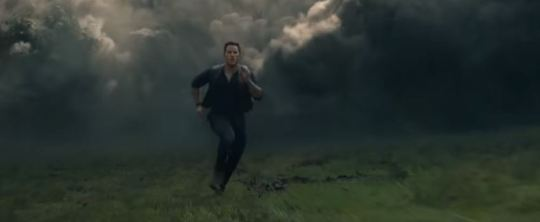
1) Pyroclastic flows will kill you almost instantly, you cannot survive a direct hit
Movies guilty of this: Jurassic World: Fallen Kingdom, Dante’s Peak
Pyroclastic flows exceed 100km/h and reach temperatures over 1,000°C. You definitely cannot outrun it in either car or on foot. The boiling hot toxic gas, ash, and lava in the flow will kill you instantly and pummel your smoking corpse into oblivion. Sorry, Chris Pratt.
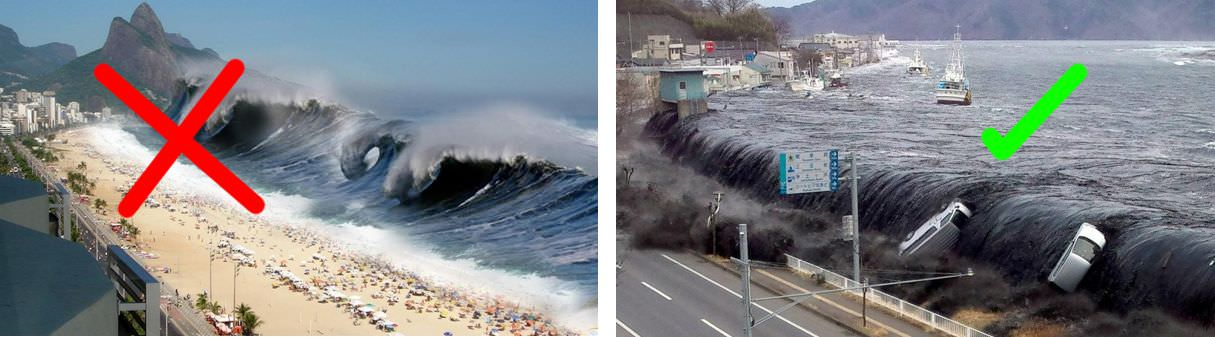
2) Tsunamis do not crest, they are more like a sudden flood than a wave
Movies guilty of this: Literally any movie with a tsunami ever
Tsunamis are massive and sudden floods caused by the displacement of ocean water due to earthquakes or massive landslides. They’re not tidal waves and thus do not crest. It’s poetic, but inaccurate.
3) Hail is always spherical and doesn’t fall in big cinder blocks of ice
Movies guilty of this:The Day After Tomorrow
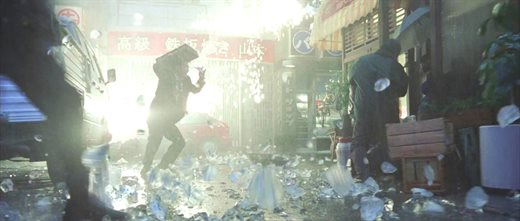
Hail can get quite large and can definitely be fatal, but they are exclusively spherical. Hail is formed by water droplets cycling through the updrafts of a thunderstorm and the rotational movements make the resulting hail a ball.
Looks more like a stage hand is throwing the remains of an ice swan than a hail storm
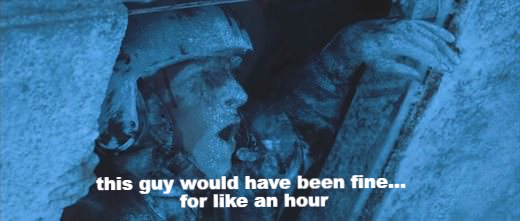
4) You cannot freeze instantaneously. Not even in space.
Movies guilty of this: The Day After Tomorrow, Geostorm, The Cloverfield Paradox, Sunshine
Space, and certain places on Earth, can get exceedingly cold. The coldest temperature ever recorded on Earth was −89.2 °C. That’s damn cold. But you still wouldn’t flash freeze into a peoplesicle within mere seconds. Intense cold can kill you quickly if you’re completely exposed but it would still take time before your body would be a thoroughly frozen chunk of meat. As for space, it can get quite cold, but it’s also an empty vacuum. There’s nothing around you but empty void, which means there’s also nothing to transfer your body heat away from you. Without convection, your body heat would be lost via radiation and that can take a long time.
5) Earthquakes over 10 on the Richter scale are physically impossible on Earth.
Movies guilty of this: 10.5
You would need a massive fault line to carry that sort of energy. Something on the scale of going through the earth’s core. Which does not exist . Even then, if such an earthquake would occur, the planet would literally explode.A 15 magnitude earthquake would release energy on the magnitude of 1×10^32 joules. That, coincidentally, is the same amount of energy contained in the gravitational binding of the Earth. Simply put, anything greater than 9.9 on the Richter scale is impossible and would cause the Earth to explode.
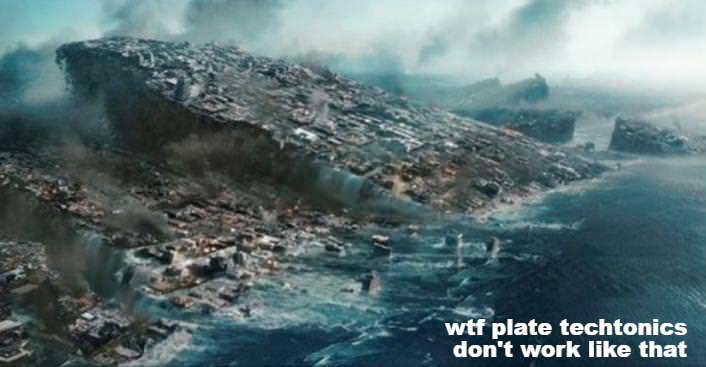
6) California will and can not sink into the Pacific like a big slab, and it can’t break away from the rest of the US.
Movies guilty of this: 2012, 10.5
Most movies cite the San Andreas fault as the reason for the cleavage, but even this isn’t enough. The San Andreas fault is a transform fault, meaning the North American plate and the Pacific Plate are slowly horizontally grinding past each other, not pushing away. As California is a part of the greater Pacific plate, it literally could not snap free from it to “sink into the sea”. Because if the entire tectonic plate underneath California where to flip over and sink then the entire ocean would drain away into the mantle.
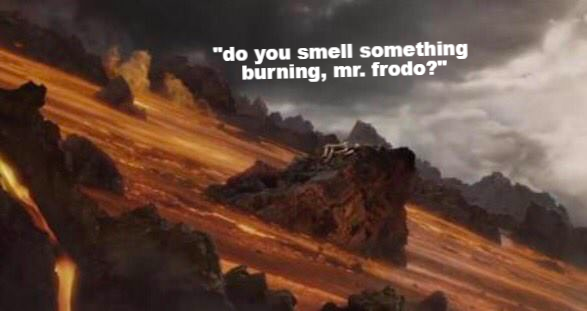
7) You can’t sink in lava. You also can’t stand near it without being burned.
Movies guilty of this: Volcano, Lord of the Rings: Return of the King
Lava is molten rock, and is incredibly dense. In fact, it’s three times as dense as humans, who are mostly water. If you were to cannonball into a lava pit, you would dip in a bit before bouncing to the top and floating. You would also burn up and die super quickly. Because fresh lava can exceed 1,200°C! Even standing a couple feet away from a lava flow, you would feel the intense heat radiation. You would lose your eyebrows and probably the top layer of your skin if you stood too close. There’s a reason why volcanologists wear protective suits. Sam and Frodo would have been roasted.
Concept: Les Misérables (1862) but if Lemony Snicket was the author
Example: to Enjolras–darling, dearest, dead.
Chapter One
If you’re seeking a story whose tragic beginning is followed by a less-tragic middle and an inevitably uplifting denouement, this book should be avoided at all costs. The approximately six hundred and fifty-five thousand words that are about to follow contain the tales of several bright and brave young people who each meet an unfortunate end and several less-bright, less-young people, including myself, who unfortunately survive to recount the events. “Unfortunate” is a word which here means “luckless” and “miserable”, the latter definition having been used for the title of this novel, designed to dissuade you, the misguided reader, from continuing past the cover page.
There are other techniques I have employed in this book that are designed to stop you from yourself becoming miserable by reading this story in its entirety. Firstly, the physical novel, which as you may notice shares the same dimensions and weight as a standard housing brick, for the utmost inconvenience. Secondly, I have included several hundred pages of information which are both uninteresting and have little bearing on the grander story in the meager hope that you will come to your senses and place this novel back on your shelf or better, in a lit fireplace, where I solemnly believe it belongs.
For example, the use of candlesticks. The word “candlestick” is derived from the purpose of the item itself, that is an object, most often metal, commonly silver, in which one can stick a candle. Many dictionaries define “candlestick” as
“an often ornamental holder for securing a candle or candles”. “Candleholder” is another, less commonly used word for “candlestick”. Candlesticks come in a variety of forms and sizes, and can contain a variety of numbers of candles often demarcated by their names-a “trikirion” contains three candles and a “menorah” contains seven. If you have had the fortitude-a word which here means “strength of mind”-to make it this far through this dull paragraph, it may be of some note to say that the candlesticks with which we concern ourselves in this story are single candlesticks, that may each contain one candle.
Thirdly, not only have I named the main character in a redundant manner-Jean Valjean-I have decided to tell you here that Jean Valjean perishes on the final page of this novel. That is my story’s conclusion.
With all this information in mind, and having the ending already known, I now give you my final warning and pleading suggestion to forget about this book. Put it down. Hide it away. Bury it in a cemetery late at night with the assistance of a man named Fauchelevant. Forget it ever existed. For now the story must begin.
It begins in a town called Digne, on a grey and dreary night under the roof of a very kind but elderly and poor man, the bishop of the town, whose name was Myriel.








 Plot Designing