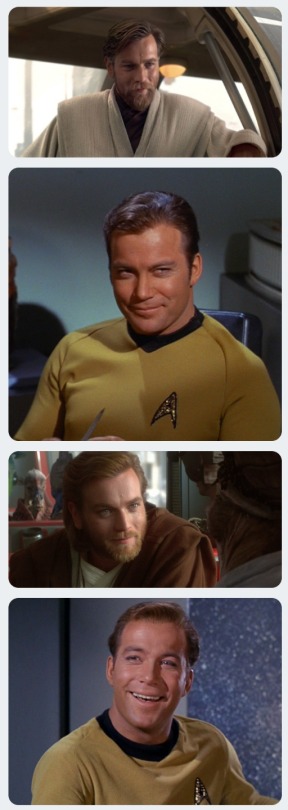
why do people try to pit star wars and star trek against each other when we all know damn well jim kirk would be all over that psychic twink with a laser sword
OP you are so wise
The meeting of James. T. Kirk and Obi-Wan “Always Fucking Flirting” Kenobi would be AMAZING.
Me: My Dragonborn pulls out her symbol and tells the party that she’s a cleric.
Unknowing to the party, her deity is Tiamat. Her symbol looks like a 3 pointed star with some dragon heads designed on each extension. It represents this diety as there’s a flat painting of a white and a black dragon. Their heads and necks chase each around the circle in a clockwise direction much like a yin and yang illustration in the middle of the amulet while 3 other different colored dragon heads protrude on their own facing the same direction clockwise. The outer heads are embossed and sculpted with fine detail rendering three different dragons about 100 degrees apart as their necks meet at the center circle with the two black and white dragons. This strange object glistens as it’s being shown to the party while they pander about it’s significance.
The party seems to be understanding what I’m explaining as I add one more horrific detail to make it painfully clear.
My cleric holds the middle of the symbol between her thumb and pointer finger, flicks the symbol with her other hand and the 3 dragon heads spin for a very long time. And then almost at the same time the players realize the shocking truth.
The question I get the most is how I write characters that feel like real people.
Generally when I’m designing a human being, I deconstruct them into 7 major categories:
1. Primary Drive 2. Fear: Major and Secondary 3. Physical Desires 4. Style of self expression 5. How they express affection 6. What controls them (what they are weak for) 7. What part of them will change.
1. Primary Drive: This is generally related to the plot. What are their plot related goals? How are they pulling the plot forward? how do they make decisions? What do they think they’re doing and how do they justify doing it.
2. Fear: First, what is their deep fear? Abandonment? being consumed by power? etc. Second: tiny fears. Spiders. someone licking their neck. Small things that bother them. At least 4.
3. Physical desires. How they feel about touch. What is their perceived sexual/romantic orientation. Do their physical desires match up with their psychological desires.
4. Style of self expression: How they talk. Are they shy? Do they like to joke around and if so, how? Are they anxious or confident internally and how do they express that externally. What do words mean to them? More or less than actions? Does their socioeconomic background affect the way they present themselves socially?
5.
How they express affection: Do they express affection through actions or words. Is expressing affection easy for them or not. How quickly do they open up to someone they like. Does their affection match up with their physical desires. how does the way they show their friends that they love them differ from how they show a potential love interest that they love them. is affection something they struggle with?
6. What controls them (what they are weak for): what are they almost entirely helpless against. What is something that influences them regardless of their own moral code. What– if driven to the end of the wire— would they reject sacrificing. What/who would they cut off their own finger for. What would they kill for, if pushed. What makes them want to curl up and never go outside again from pain. What makes them sink to their knees from weakness or relief. What would make them weep tears of joy regardless where they were and who they were in front of.
7. WHAT PART OF THEM WILL CHANGE: people develop over time. At least two of the above six categories will be altered by the storyline–either to an extreme or whittled down to nothing. When a person experiences trauma, their primary fear may change, or how they express affection may change, etc. By the time your book is over, they should have developed. And its important to decide which parts of them will be the ones that slowly get altered so you can work on monitoring it as you write. making it congruent with the plot instead of just a reaction to the plot.
That’s it.
But most of all, you have to treat this like you’re developing a human being. Not a “character” a living breathing person. When you talk, you use their voice. If you want them to say something and it doesn’t seem like (based on the seven characteristics above) that they would say it, what would they say instead?
If they must do something that’s forced by the plot, that they wouldn’t do based on their seven options, they can still do the thing, but how would they feel internally about doing it?
How do their seven characteristics meet/ meld with someone else’s seven and how will they change each other?
Once you can come up with all the answers to all of these questions, you begin to know your character like you’d know one of your friends. When you can place them in any AU and know how they would react.
writing conclusions in papers is like the stupidest thing ever though like what’s the point of dedicating an entire paragraph to “so yeah i know you just read my paper but this is a summarization of what you read in case you need to be reminded about what you just read” like why can’t the paper just end
I keep seeing this post and similar ones, and if y’all’s teachers and professors have left you with the idea that a conclusion is a summary, they have failed you in a big way.
Your conclusion is your “so what’s the fucking point” section. You’ve given you’re reader a lot of info and now they need to know why they care. Depending on the type of paper you should be giving a plan of action, explaining how this knowledge changes our understanding of the topic, link your paper to other disciplines, suggest further areas of study, etc.
One of the best pieces of writing advice I’ve ever received is that if you can’t envision yourself dropping the mic and strutting off stage at the end of your conclusion then it’s probably not strong enough.
“So whats the fucking point” is more helpful than all 6 years I’ve probably been writing papers





 Plot Designing