When is this country going to have a real revolution? I dont want to sound like an anarchist but come on, we all know the problems and our government isn’t addressing it.
No, pls sound like an anarchist cuz that’s the only way shit will get done
In science fiction, AIs tend to malfunction due to some technicality of logic, such as that business with the laws of robotics and an AI reaching a dramatic, ironic conclusion.
Content regulation algorithms tell me that sci-fi authors are overly generous in these depictions.
“Why did cop bot arrest that nice elderly woman?”
“It insists she’s the mafia.”
“It thinks she’s in the mafia?”
“No. It thinks she’s an entire crime family. It filled out paperwork for multiple separate arrests after bringing her in.”
I have to comment on this because this is touching on something I see a lot of people (including Tumblr staff and everyone else who uses these kind of deep learning systems willy-nilly like this) don’t quite get: “Deep Reinforcement Learning” AI like these engage with reality in a fundamentally different way from humans. I see some people testing the algorithm and seeing where the “line” is, wondering whether it looks for things like color gradients, skin tone pixels, certain shapes, curves, or what have you. All of these attempts to understand the algorithm fail because there is nothing to understand. There is no line, because there is no logic. You will never be able to pin down the “criteria” the algorithm uses to identify content, because the algorithm does not use logic at all to identify anything, only raw statistical correlations on top of statistical correlations on top of statistical correlations. There is no thought, no analysis, no reasoning. It does all its tasks through sheer unconscious intuition. The neural network is a shambling sleepwalker. It is madness incarnate. It knows nothing of human concepts like reason. It will think granny is the mafia.
This is why a lot of people say AI are so dangerous. Not because they will one day wake up and be conscious and overthrow humanity, but that they (or at least this type of AI) are not and never will be conscious, and yet we’re relying on them to do things that require such human characteristics as logic and any sort of thought process whatsoever. Humans have a really bad tendency to anthropomorphize, and we’d like to think the AI is “making decisions” or “thinking,” but the truth is that what it’s doing is fundamentally different from either of those things. What we see as, say, a field of grass, a neural network may see as a bus stop. Not because there is actually a bus stop there, or that anything in the photo resembles a bus stop according to our understanding, but because the exact right pixels in the photo were shaded in the exact right way so that they just so happened to be statistically correlated with the arbitrary functions it created when it was repeatedly exposed to pictures of bus stops over and over. It doesn’t know what grass is, what a bus stop is, but it sure as hell will say with 99.999% certainty that one is in fact the other, for reasons you can’t understand, and will drive your automated bus off the road and into a ditch because of this undetectable statistical overlap. Because a few pixels were off in just the right way in just the right places and it got really, really confused for a second.
There, I even caught myself using the word “confused” to describe it. That’s not right, because “confused” is a human word. What’s happening with the AI is something we don’t have the language to describe.
Anyway what’s more, this sort of trickery can be mimicked. A human wouldn’t be able to figure it out, but another neural network can easily guess the statistical filters it uses to identify things and figure out how to alter images with some white noise in exactly the right way to make the algorithm think it’s actually something else. It’ll still look like the original image, just with some pixelated artifacts, but the algorithm will see it as something completely different. This is what’s known as a “single pixel attack.” I am fairly confident porn bot creators might end up cracking the content flagging algorithm and start putting up some weirdly pixelated porn anyway, and all of this will be in vain. All because Tumblr staff decided to rely on content moderation via slot machine.
TL;DR bots are illogical because they’re actually unknowable eldritch horrors made of spreadsheets and we don’t know how to stop them or how they got here, send help
This stuff is cool and much more interesting than the general-AI doomsaying anyway (which I will drag in the tags anyway). 🙂
Yo ADHD folks are you looking for an app to help you remember to get stuff done?
Because if so I’d like to recommend Habitica!
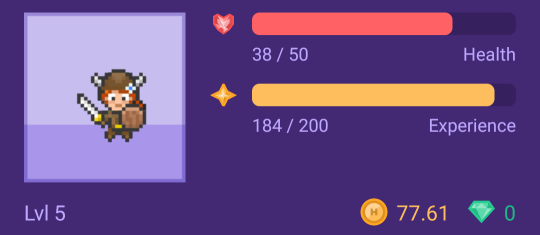
You make a little avatar of yourself!
Totally customizable!
And!!! If you’re wheelchair bound, guess what! Wheelchairs for your avatar are free! Check it out!
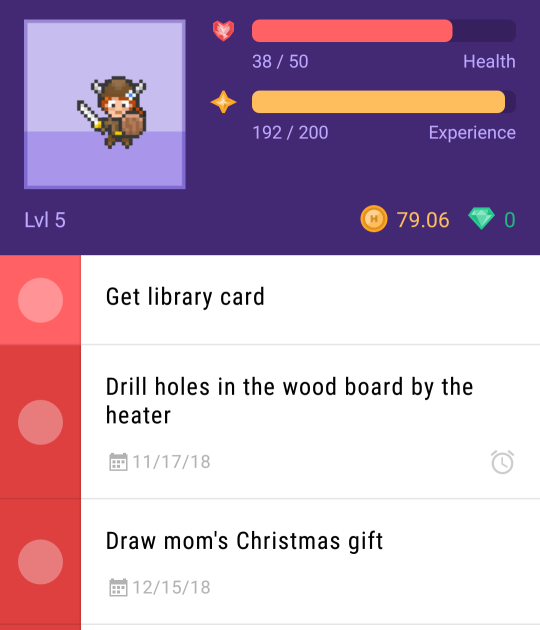
You have the categories of Habits, Dailies, and a To-Do list
And every time you check something off, you get health and XP!
Huzzah! I leveled up!
Use your XP to buy items and rewards!
I’ma give my little avatar a new helmet!
You also can get little pets!
I hatched a dragon!
Go on quests!
Need a break? Check in at the Tavern for as long as you need!
It’s a habit tracker and to-do list… As a video game!
And here’s the best part – ITS FREE!
I have gotten so much better at getting things done because when I do I get to check in and get a reward right then! It really works for my ADHD brain so, so much better than just a regular ol checklist and I just really recommend checking it out!
For my fellow ADHD Famders, since I know there are so many of us!
Can someone put together a universal theory for why Tumblr loves Halloween to a fault but hates Christmas
Tumblr skews young, Halloween spent with friends, Christmas with family.
Tumblr skews young, more users want to fuck monsters than want to fuck Santa.
I have an actual theory behind this, but I won’t be able to articulate it well until I read Bakhtin and maybe some of the medieval peasant-culture anthro stuff, so I’ve been putting it off. The short of it though is: Halloween is Mardi Gras, while the “holiday season” is Lent. Christmas however is not Easter; the closest equivalent to Easter is the day after Christmas, when you are no longer exposed to Christmas shit and you can maybe get a day off if you work retail.
Over the course of my lifetime Halloween has transmuted very noticeably into a kind of peasant carnival. I think this is because its colonization by commercial forces focused entirely on trick-or-treating, and its religious associations are nonexistent here, so above trick-or-treating age it was left completely to “the folk” to do what they wanted with.
Basically there’s two distinct elements to modern Halloween: the first is that it acts out, and thereby creates, a sense of mastery over and comfort amidst the anxieties of life – death, and monsters, and horror, and so forth. These are several steps removed from the actual sources of people’s fears, but they represent them. The posture of being at home, amongst family, in the company of death and horror is a way of grappling with the senseless horror of life.
The second aspect is that Halloween flouts the pieties of conventional society, whereas Christmas embodies them. Therefore, Christmas is the anti-Halloween. Since it’s America, bland corporate pleasantries and hyperconsumerism are themselves pieties, and as more and more of the population shifts into the service sector, the number of people who experience those things like an imposition from on high increases. The reason everyone starts celebrating Halloween as early as possible, yet dreads when the same thing happens at Christmas, is because Christmas is a “high” holiday that embodies the norms and culture of the upper-middle-class. Halloween is a vulgar party whereas Christmas is a
genteel
sermon; the commercialization of Christmas only changes the church and God.
My theory: it’s the creator vs curator debate.
Halloween involves making things and performing weirdness publicly, Christmas involves paying money to hope you guessed correctly about someone else’s preferences.
also we’re all broke and at least in my clusterfuck of a family there’s a competitive aspect to gift giving that provokes low-grade anxiety until it’s over.
I think this is probably true, but I think it’s true to some extent because Halloween has not been extensively “monetized” outside of trick-or-treating, despite the efforts of the Sexy and/or Hilarious Party Costume industry. If we put a hedge fund in charge of Halloween I have no doubt they’d make buying everything premade mandatory and restructure the whole thing around spending money to quell low-grade social anxiety, just like with everything else.
I can’t totally agree with this latter part because: Christmas decorations.
I feel like I should expand but I’m really not sure what to say. Christmas decorations can easily be as individualistic, hokey, home-made, or weird as… Well, there’s less license than Halloween but a heck of a lot more than for any other American holiday.
Not o butt in and derail, but there’s undeniably an aspect of- as discoursedrome mentions- the total absence of widespread religious associations with Halloween.
That means for the atheists and pagans and jews and muslims and buddhists and lapsed christians and anyone for whom Christmas is a two month long stress exercise where the goal is to avoid a fist fight with every single fucker who keeps assuming you’re Christian no matter how annoying it is, and worse, may have the fucking balls to try to convert you if you point it out?
Halloween is actually a celebration. Where Christmas is a solid 6-8 weeks of hearing people who literally dominate every aspect of your society talk about how they need to be even more dominant, and how everyone else should be grateful for that domination because at least it’s “fun.”
So, there’s just, immediately, a much larger population of people for whom Halloween is accessible, compared to Christmas.
Tumblr skews American, and in America, Halloween is an acceptable inversion festival. That’s not the right word for it, but people interested in anthropology/history/theology can give you the right one. I remember that @copperbadge actually wrote about it here, but there’s a word for it that I’ve forgotten. Anyway, these festivals are deliberately anti-normative and provide an acceptable way for the public to skew/invert social mores, which is thought to be useful (source needed) as a sort of release valve for stressed-out societies, who spend the rest of the year picking over their inhibitions and repressions. Halloween just happens to be the way that the Puritan-influenced United States manages to invert its traditions. But in other cultures, Christmas actually has inversion rituals!
There are actually a lot of inversion traditions associated with Midwinter in the UK – wassailing, the Feast of Fools, the concept of mumming, probably even Morris Dancers, mystery plays, and figures like the Lord of Misrule – all of which have an inverted character.
There is a lot of weird, freaky, morbid pagan stuff like the Mari Lwyd, the undead Welsh horse who goes trick-or-treating at Christmas, demanding alcohol with a menacing song, and you have to try to send her away in song form; when you run out of reasons to keep her out, you must invite her in and give her alcohol. The Grey Mare is played by a real horse’s skull and a sheet draped over a man, with a stick that allows him to snap the jaws menacingly at people, terrifying the shit out of children. This has a very American-Halloween feel, but she’s very strongly a Christmas-season character, who comes during the darkest nights of Midwinter with her festive red and green ribbons.
Figure 1. WHO IS SHE
“Mumming” is a weird relict of medieval?pagan? tradition in the UK and it’s what “The Mummer’s Dance” by Loreena McKennitt is about. People dress up. It often involves the Christmas Mystery Play, which involves St George being killed by a dragon; he is then revived by The Doctor, and kills the dragon. This is considered to be extremely Traditional and Christmassy. Here is The Doctor, clearly taking some inspiration from the modern Doctor Who, who probably took some inspiration from him, in turn; The Doctor is about to revive St George with a magic potion in a spray bottle. Santa is also there, and people with significant hats. We are all encouraged to believe that this is extremely Christian and normal.
Figure 2. This is the true meaning of Christmas, if you didn’t know.
In continental Europe, which I know less about, there are even more Midwinter/Christmas inversions, like the Krampus and the Yuletide-Lads (chaotic-neutral Icelandic elves).
Figure 4. “no guideposts to sense-making are set forth by adults” is a very millennial experience
So why does Tumblr like Halloween so much?
Possibly because it’s a culture strongly influenced by Americans, and further by Americans whose coming-of-age was influenced by 9/11, whose experience of Halloween was one of the rare times that the powerless felt powerful, when strict social hierarchy was relaxed, when different roles and attitudes could be safely explored, and the cultural themes of death/doom/fear were inverted into something that was enjoyable.








 Plot Designing