Look I know this is a shit post fuelled by staying up too late on my phone and an extended Gd-awful cold from hell but there are absolutely Tons of Large Weird Birds in the Cenozoic and it’s 100% possible to make an awesomebro-style documentary just about dead birds and people who have limited Cenozoic Bird coverage to just Gastornis and Terror Birds are
Cowards
Alright it’s a new day and I’m still ridiculously ill so I’m back with some great candidates for your Awesomebroy Documentaray on Cenozoic Birds and how Freaking Weird They Are
These guys were large, flightless predatory birds with small wings that lived from the end of the Paleocene to the beginning of the Pleistocene in South America (and later on in North America). You could literally pick any time to have these guys running around and wreaking havoc. You can EVEN HAVE THEM FEEDING ON OTHER BIRDS like this Strong!Rhea below
They are actually closely related to Terror Birds but they lived in North America from the Eocene to the Miocene, and they were also large, long-legged predators of other food. The main difference is basically range and the fact that they had longer wings – most of them were still flightless but some of them could still fly which is terrifying
While I’ve got you here with Cariamiformes aka Seriemas and their weird-ass dead relatives we also have things like Strigogyps and Idiornis which were essentially like modern seriemas but smaller and all over the place during the Paleogene, and also mother-fucking qianshanornis that had a fucking SICKLE CLAW LIKE A DROMAOESAURID RAPTOR this was basically a PALEOCENE DROMAEOSAUR except a Neornithine bird
this illustration by Apokryltaros doesn’t do it justice but I work with what I’ve got
If Seriemas and their compendium of terrifying dead cousins don’t tickle your fancy just fucking wait I’ve got more
The Gruiformes aka Crakes Cranes and Rails and shit were weirdly morphologically diverse back in the day and they did more than Wade in the Water
Eogrus and its relatives were essentially Crane Ostriches they also only had two toes and were probably built mainly for running they lived from the Eocene to the Pliocene in Eurasia and all I have to work with again is bad wikipedia illustrations but here it is the freaking weirdo
By Tim Morris
But wait! There’s also the Adzebill!!!!!
By Nobu Tamura
These were ALSO large flightless relatives of modern cranes and they were JUST in New Zealand from the Miocene to RECENT TIMES aka the Holocene and they had long pointy beaks so they could hunt for small animals like lizards and tuatara and OTHER BIRDS in their habitat and they WEREN’T the only large birds in New Zealand because New Zealand is essentially DINOSAUR LAND 2: THE FEATHERING cause it was isolated from mammals apart from bats until humans showed up and ruined everything so we have
By Jack Wood
Haast’s Eagle, one of th elargest known flying birds that hunted
Freaking Moa, the large flightless ratites that basically were the Charismatic Megafaunal Herbivores of New Zealand and they lost their wings and looked so trippy but also so cool and they were HUNTED ON BY GIANT EAGLES
By John Megahan
I just. Have some. Some important. Questions. WHY THE FUCK HAVE I NEVER SEEN THIS MAGICAL LAND IN A MAJOR DOCUMENTARY. There were also a bunch of really cool other birds in New Zealand that are pretty unique to New Zealand (and some of them are still around today like New Zealand Wrens and The Kakapo!) but I’m trying to stick to charismatic megafauna type shit for this list the whole point is that you can make an AWESOMEBROY documentary JUST ABOUT CENOZOIC BIRDS very easily anyway
Speaking of large flightless ratites we also have the Elephant Bird from Madagascar which I NEVER SEE TALKED ABOUT except for like the context of “largest bird” which for the record it might not be I don’t have a good skeleton of it but there were lots of different kinds of Elephant Birds in Madagascar and they were basically the large herbivores of the area doing their thing and There is ALSO Eremopezus which was a large flightless bird from the end of the Eocene so an EARLY ONE and we have NO IDEA what kind of ratites it was closely related to or even if it IS a ratite and it would have been a ridiculously large bird and STAY TUNED FOR MORE OF THAT MYSTERY
There are also, of course, ratites in the Cenozoic – such as the Emuary, which is literally just an early relative of both Emus and Cassowaries thats a cross between the two, lots of extinct Ostrich and Rhea relatives – like the Strong!Rhea above and of course various ostriches that spread all over the Eastern Hemisphere, and the Lithornithids!
LITHORNITHIDS 👏DESERVE 👏MORE 👏PRESS 👏 THEY 👏WERE 👏PERCHING 👏RATITE-COUSINS 👏THAT FLEW AND SORED 👏ALL OVER THE EARLY PALEOGENE 👏👏👏👏👏👏I’M VERY BITTER
SPEAKING of Bitterns and their relatives (ha ha I’m hilarious) we DO HAVE dead shoebill relatives from Egypt called GOLIATHIA and there are also GIANT. IBISES. GIANT IBISES. FLIGHTLESS, GIANT IBISES. Called the Jamaican Ibis.
And I hear you, by this point you might be saying “but like, the hallmark of any discussion of Cenozoic fauna is talking about the evolution of whales which is a Trip and there isn’t an analogous thing in birds is there” and I hear you. I hear. you. My counterpoint is: the evolution of PENGUINS
By Nobu Tamura
THEY WENT FROM FLIGHTED SMALL BIRDS TO LOON-LIKE-THINGS (note: penguins are NOT CLOSELY RELATED TO LOONS) to WEIRD LARGE BIRDS WITH LONG SHARP BEAKS GOOD FOR STABBING –
WE EVEN KNOW THE COLOR OF SOME OF THEM (by Apokryltaros)
AND. THEY. GOT. FUCKING. H U G E (size comparison by Discott)
They aren’t the only dead birds that got to look like that though. There were other very aquatic birds back in the day – like the relatives of modern Boobies from Japan, the Plotopterids – they lived rom the Eocene to the Miocene, they were huge, and they were the “Northern Hemisphere’s Penguins”
By Nobu Tamura
And of course we can’t forget the Great Auk which is literally named Pinguinus and needs No Introduction
By Mike Pennington
Okay while we’re on the subject of large aquatic birds HAVE YOU HEARD OF THE SWIMMING FLAMINGOS
By Ghedoghedo
THESE GUYS WERE BIG. THESE GUYS WERE LONG. THESE GUYS WERE FREAKY LOOKING. THESE GUYS HAD SHARP STABBY BEAKS. AND THEY LIVED FROM THE OLIGOCENE TO THE PLIOCENE AND ARE A WEALTH OF WEIRD FREAKINESS AND MY ONLY REGRET IS THAT I DON’T HAVE A RECONSTRUCTION FOR YOU.
Oh wait while we’re talking about flamingos have I MENTIONED THE DUCKS THAT EVOLVED TO BE WEIRD FLAMINGO-MIMICS
THIS IS TEVIORNIS (by @thewoodparable) FROM THE CRETACEOUS BUT IN THE PALEOGENE THEY GOT EVEN WEIRDER AND SKINNIER AND FLAMINGO-Y-ER BUT WITH DUCK BILLS INSTEAD OF THE HOOK THINGS OF FLAMINGOS AND THEY MIGHT HAVE LIVED ALL THE WAY UNTIL THE OLIGOCENE –
THIS IS WILARU ITS FROM AUSTRALIA AND IT WAS MORE TERRESTRIAL AND VERY STRONG/ROBUST IT WAS A BIG BOY
Okay, okay. I know what you’re thinking. You heard me mention Ducks and you think I’m holding out on you. Fine. Fine. I have neglected to mention the only reasonably famous Cenozoic Bird.
Yes, there’s Gastornis. And while I probably would say “nope, we don’t need that, it’s been in everything,” I will acknowledge that to my knowledge it has never been represented as it was IN LIFE. We USED to think these weirdos were large predatory birds in their habitats like the Terror Birds would one day be.
TURNS OUT WE WERE WRONG.
Gastornis and its relatives were actually HERBIVORES. Giant, flightless, convergent-on-PARROTS-HERBIVORES. They would USE THEIR GIANT BEAKS TO BREAK OPEN FRUIT. THEY WERE WEIRD CASSOWARY-PARROT-DUCKS and SHOW THEM THEIR PROPER RESPECT.
They also weren’t the only LARGE FLIGHTLESS DUCK THINGS
By Nobu Tamura
DROMORNIS AND ITS RELATIVES may or may not be closely related to Gastornis we don’t actually know and they were Australian and Huge and they lived from the Oligocene to the Pleistocene and they were ALSO herbivores and they ALSO had tiny wings and they were ALSO huge and there were more of them than there were of Gastornis and they ALSO were probably like parrots in cracking open fruit and other things with their huge beaks and even though they were fairly robust they could still run fast using the power of BRUTE STRENGTH
BRUTE STRENGTH RUNNING
Also let us PLEASE not forget the gaggle of Quaternary-period Large Flightless Goose-like Ducks from Hawai’i because these guys were AWESOME, WEIRD and in a lot of ways very cute and worth mentioning. They also had fun names like Small-Billed Moa-Nalo, Ptaiochen –
And Thambetochen –
And my personal favorite, the Turtle-Jawed Moa-Nalo, which not only is adorable, but has an absolutely ridiculous genus name – Chelychelynechen
like
why
All illustrations of these weirdos are by Apokryltaros
And in the realm of waterfowl, ALSO don’t forget that there was an Island off the coast of Italy with TINY ELEPHANTS but more importantly GIANT SWANS OF DOOM THAT WOULDN’T HAVE EATEN THEM BUT WOULD HAVE CHASED THEM AWAY BECAUSE, LIKE ALL SWANS, THEY WERE ASSHOLES
The teratorns were relatives of New World Vultures aka things like Condors; they lived in North and South America from the Oligocene to the Pleistocene (so you can absolutely have a Terror Bird eating the carcass of a Rhea while a Teratorn circles overhead looking for nibbles) and they were huge, soaring animals with impossibly large wingspans and we have tons of fossils of these guys including from the LA BREA TAR PITS so there’s THAT for charismatic localities
By Nobu Tamura; TERATORNS
By the way there are a lot of birds from La Brea not just Teratorns there are tuns of Eagles and Vultures (including Old World Vultures which were in the New World until humans got there basically so that’s an interesting Thought) and Ducks and Sea Birds and Giant Storks –
By Ellen
And pigeons and Caracaras and turkeys and songbirds and woodpeckers and grebes and egrets and cranes and owls –
By Apokryltaros
OH CRAP OWLS
OWLS
O W L S you guys
First off I find it very important to note that we actually have a halfway decent evolutionary sequence for owls
By Ghedoghedo
but BEYOND THAT we have the RIDICULOUS STILT HOWLS that were the largest owls to ever exist and they were probably flightless and they lived in places like Cuba and they had long legs and were very strong and they probably could run around like maniacs and they were basically convergent on seriemas? I’d say?
By Apokryltaros
Like what the fuck. What the. Fuck. Fucccck. Fuck.
While I have you here with birds of prey hav eyou heard of the Flexiraptor?
The Flexiraptor, or Pengana, is basically a cross between a Secretary Bird and a Caracara (though it’s most closely related to thinks like Eagles and Hawks) from Australia in the Miocene (actually, it’s from Riversleigh, which has lots of other really good birds like early modern-ish parrots and passerines and stuff) and it had feet that were as flexible as like, human hands, which let them reach into holes and crevices to grab prey, which is freaking awesome, go Flexiraptor
Also, may I remind you that the earliest parrots were birds of prey
These birds were small but had parrot feet and beaks built for grabbing other animals and CRONCHing them. PARROTS OF PREY.
Finally. The thing you’ve all been waiting for. The birds that are a CRIME that I’ve never seen them in a single documentary thing and as far as I’m aware the only attempt to represent them in media has been in fucking Ark: Survival Evolved.
The Pseudotoothed Birds.
By Didier Descouens
ARGHHHHH WHY HAVE THESE NEVER BEEN SHOWN IN ANYTHING
PSEUDOTOOTHED BIRDS WERE RIDICULOUSLY COMMON BIRDS THROUGHOUT THE ENTIRE CENOZOIC
THEY ONLY WENT EXTINCT RECENTLY
THEIR MOUTHS LOOK LIKE SOMETHING OUT OF A HORROR FILM
We have NO IDEA what these guys were related to, they were most definitely sea-birds though but they might be closely related to ducks or they might be closely related to modern seabirds we really just don’t know, and they were everywhere – North America, Europe, Africa, Asia, South America, New Zzealand, EVERYWHERE. EVERYWHERE AND EVERYWHEN. they only went extinct 2.5 MILLION YEARS AGO. They also had RIDICULOUSLY LONG WINGS
By Ryan Somma
THEY WERE ALSO SOME OF THE LARGEST FLYING BIRDS WE KNOW OF
FREAKING. HUGE. SOARING. MONSTROSITIES OF TERROR.
By El Fosilmaníaco
Just. Just picture. You’re an early Hominid. On the beaches of Africa. Staring out at the sea. And you see a bird. That looks like a normal seagull or something. Just normal. And then you look closer.
By Jaime A. Headden
AND YOU SEE THE DEMON SHARP PROJECTIONS OF THE BEAK THAT TO YOUR LESS MODERN BRAIN WOULD HAVE LOOKED EXACTLY LIKE TEETH
YOU RUN
YOU FUCKING RUN
For FUCKS sake. WHY. They used the teeth to snag fish but WHY.
And, of course, there were lots of paleo environments with lots of different types of birds showing how they diversified and first evolved and what kinds of birds there are – the Messel Pit, Fur Formation, and Green River Formations all have LOTS of birds and are great windows into the Eocene Radiation of birds.
And of COURSE there are a lot of SMALL BIRDS that are really interesting and show how birds diversified during the Cenozoic and they’re really cool but THE POINT OF THIS POST IS THAT THERE ARE A SHITTON OF
CHARISMATIC AVIAN MEGAFAUNA
and ANYONE WHO LIMITS THEMSELVES TO GASTORNIS AND TERROR BIRDS when talking about birds in the Cenozoic
IS
A
COWARD
thank you for coming to my Ted Talk
If I missed anything let me know because not only do these things not get the coverage they deserve in popular representation they also have fucking terrible online resources and thank g-d Gerald Mayr exists because without him we’d all be lost
A late Cretaceous feathered dinosaur that was three metres long and armed with vicious claws called Anzy wylei has been discovered in the Hell Creek formation outcrops in Dakota, an area already famed for its multiple T-rex and Triceratops finds. Looking similar to ostriches and weighing about a third of a metric tonne, the critters are related to oviraptors, so far only knownfrom Asia (see http://tinyurl.com/o3c4269)
Don’t worry, guys. Carl is clearly a brachiosaurus, which lived during the Jurassic period. (And before anyone says our lil’ boy Steve is a velociraptor and therefore puts our comic in the late cretaceous, aka the time of the comet–that lil guy could easily be a compsognathus or a caudipteryx, both Jurassic-era species of small theropod dinosaurs. So the light getting bigger every night is going to pass by harmlessly, and Steve and Carl can go on enjoying the stars together until they die of old age, since Carl has very few natural predators at his size and I bet he’ll protect Steve, if he needs it (though small, fast and carnivorous as Steve is, he probably won’t).
So it’s all good!!
That entire response explaining how these two characters didn’t die a fiery death but instead lived long and happy lives literally made my day.
Two newly discovered dinosaurs may be missing links in an unusual lineage of predators that lived between 160 million and 90 million years ago, new research suggests.
The two species, Xiyunykus and Bannykus, were theropods—a group of bipedal, largely carnivorous dinosaurs. Some theropods eventually gave rise to birds, while another branch, the alvarezsauroids, evolved into strange-looking insectivores with short arms and hands with an enlarged finger for digging into nests.
But until now, little was understood about how this change happened because of the 70-million-year evolutionary gap separating the insect-eating alvarezsauroids from the earliest known member of the group, Haplocheirus.
“The significance of Xiyunykus and Bannykus is that they fall within that gap and shed light on patterns of evolution within Alvarezsauroidea,” explained Corwin Sullivan, a University of Alberta paleontologist who participated in the international study.
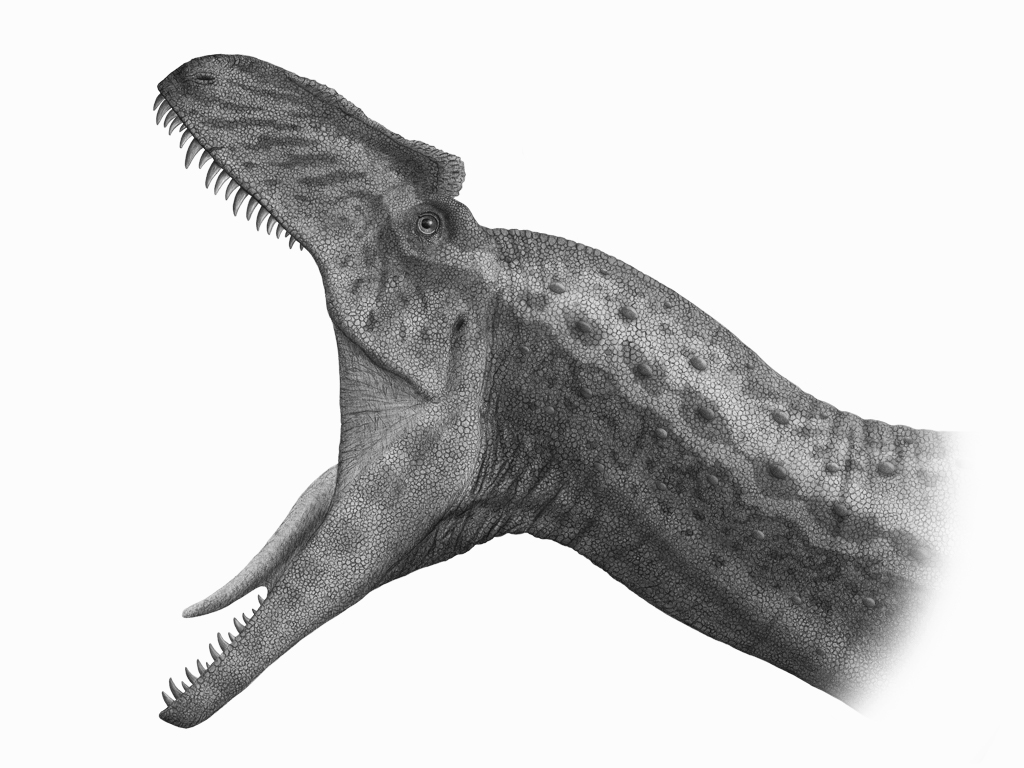
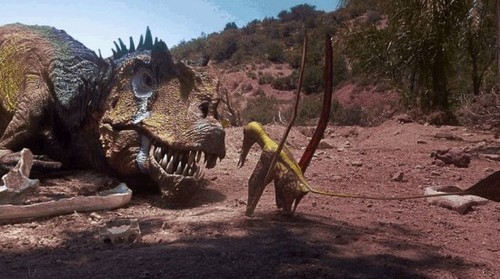
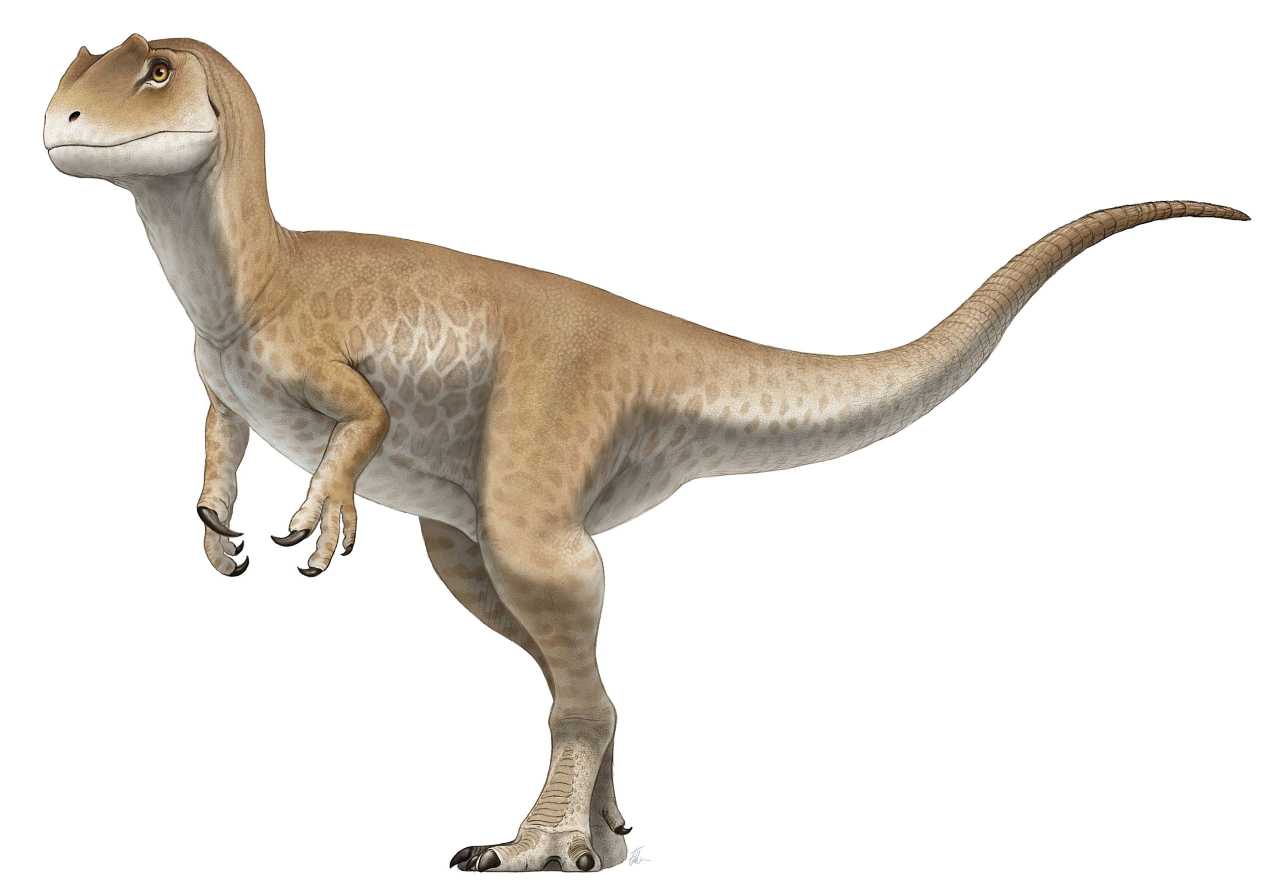
Allosaurus is by fair one of the most famous predatory dinosaurs, so much so that I’d rank it third behind T. rex and Velociraptor (perhaps in competition with Spinosaurus for that position, after Jurassic Park III,) and was one of the first well-known theropod dinosaurs, having been discovered even before T. rex. It lived between 155 and 150 million years ago in the Kimmeridgian to early Tithonian stages of the Late Jurassic period. It has fossils found in the USA (Morrison Formation), Portugal, and Tanzania, and is the most well represented large theropod ever, with many fossils found and a without-a-doubt reconstruction. It and T. rex represent the quintessential large theropod dinosaur in popular culture. It is the state fossil of Utah, and was in Arthur Conan Doyle’s novel/film The Lost World. Due to its fame, it has had many appearances in dinosaur documentaries: Walking with Dinosaurs, The Ballad of Big Al, When Dinosaurs Roamed America, Planet Dinosaur and Dinosaur Revolution all feature it. In short, we know a lot about it!
By Fred Wierum, CC BY-SA 4.0
Allosaurus is mainly known from, and originally discovered in, the Morrison Formation. The Morrison Formation is probably one of the most famous fossil discovery sites, with a vibrant dinosaur community, often considered comparable to the African savannah. Allosaurus lived in savannahs surrounded by forest, interspersed with rivers and lakes that supported many different types of dinosaurs for it to feast on – and Allosaurus would have definitely been one if, if not the, top predators. It was about 8.5 meters long, with some individuals about 9.7 meters long, or even 12.
By Steveoc 86, CC BY 2.5
The first fossil was found during the bone wars in North America, and only one species is considered valid (despite many being named to the genus over time, and many other genuses being renamed as Allosaurus. It was your all around typical theropod: long legs, short arms (not as short as T. rex though,) long tail for balance, and powerful jaws. These jaws would have been able to open up at an angle of about 92 degrees, and as such it served as a sort of axe jaw – slashing at prey over and over again until it bled out. It had small horns above its eyes that either could have served as weapons (unlikely,) to shield from the sun (more likely,) or to distinguish the species or for display (most likely.)
Allosaurus did have binocular vision, but only twenty degrees of it, making it important that Allosaurus’ prey stayed directly in front of it for Allosaurus to have any sort of depth perception of the prey. It had a brain similar to that of a crocodile, with a very large olfactory bulb, allowing Allosaurus to rely on a few well known smells such as that of carrion. It had very robust arms, which would have allowed it to grab on to prey or even mates during the mating process; this is interesting as almost all other large theropods had very weak forelimbs. The roof of its skull was fairly thin, which would have allowed for thermoregulation of the brain. Two of the most significant Allosaurus find are “Big Al” and “Big Al Two”, both found in Wyoming and both are fairly complete skeletons. Big Al was probably a subadult, with 19 broken or infected bones that probably contributed to its death. A major problem was a bone infection and trauma in its right foot that limited its movement; preventing its ability to hunt and therefore to heal. This indicated the exact difficult of life for Allosaurus, and how oftentimes their biggest enemies were each other – as depicted in The Ballad of Big Al (one of my favorite dino docs).
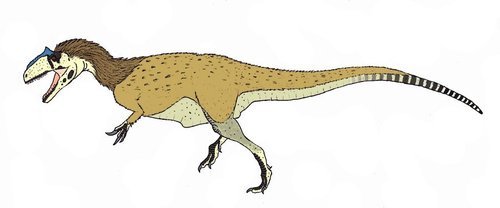
Allosaurus was the most common theropod in the Morrison Formation, living in flat floodplains and living in distinct wet and dry seasons. It lived along side the theropods Ceratosaurus, Ornitholestes, and Torvosaurus, and the sauropods Apatosaurus, Brachiosaurus, Camarasaurus, and Diplodocus, and the ornithischians Camptosaurus, Dryosaurus, and Stegosaurus. It was most commonly found with fossils of Apatosaurus, Camarasaurus, Diplodocus, and Stegosaurus. In the Portugal formations where Allosaurus was found have many similar species but a stronger marine influence, given its proximity to the coast; and lived there with Allosaurus, Ceratosaurus, Torvosaurus, Apatosaurus, Lusotitan, Camptosaurus, and Draconyx, the latter three filling similar niches as dinosaurs in the Morrison formation. Allosaurus coexisting with Ceratosaurus and Torvosaurus shows clear niche partitioning, with Ceratosaurus and Torvosaurus most active around waterways, forests and the underbrush; whereas Allosaurus would have preferred the dry floodplains and savannah. As it lived in a hot environment, and is known with scale impressions, it probably didn’t have feathers – though this hasn’t been ruled out completely, and a variety of reconstructions are shown here.
By Fred Wierum, CC BY-SA 4.0
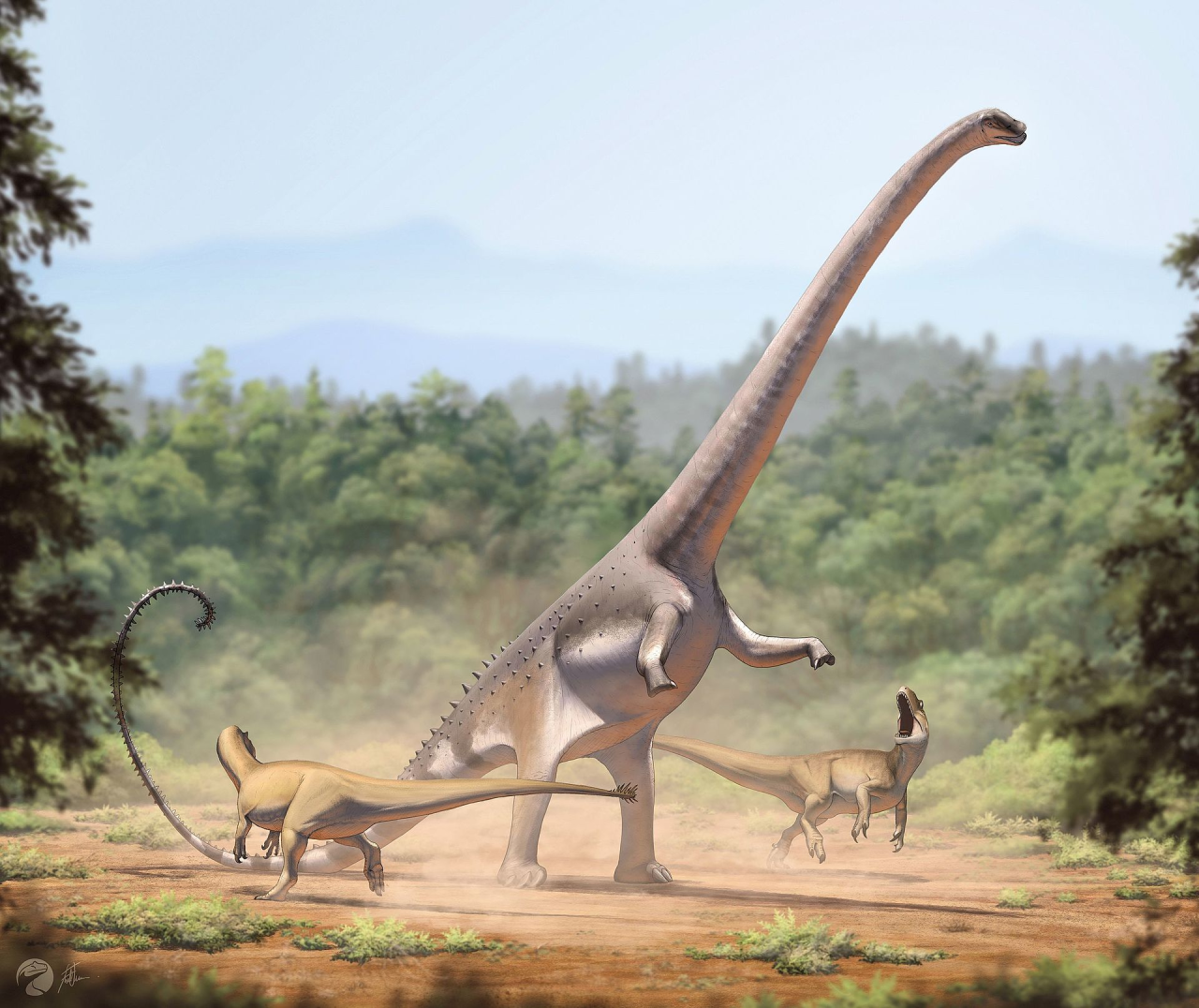
Allosaurus has been shown to stop bone deposition at 22 to 28 years, similar to other large theropods, and it stopped growing around age 15. Medullary bone tissue – a type of tissue found only in female birds laying eggs, since it gives calcium to egg shells – has been found in one Allosaurus individual, allowing for it characterization as an egg-laying female, or at least one that reached reproductive age. It has also been found that juveniles had longer hind legs than adults, suggesting that the younger Allosaurus were faster than the adults and probably chased their prey, where the adults would rely on ambush strategies. It is widely agreed that Allosaurus was an active predator, given evidence that it attacked Stegosaurus, and sauropods being their most likely candidates for prey and scavenging, giving scrapings on sauropod bones and teeth with their bones. It probably wasn’t a predator of fully grown sauropods unless it hunted in packs, which was probably likely in the case of juvenile Allosaurus. It had a strong jaw with a small biting force, using the saw-like jaw to slash on large prey, weakening the victim. Its top speed would have been about 30 to 55 kilometers (19 to 34 miles) per hour.
Juvenile by Fred Wierum, CC BY-SA 4.0
It has widely been hypothesized that Allosaurus cared for its young, given shed allosaur teeth and large prey animal bones chewed up that Allosaurus could bring back to their lairs. However, this is still under wide debate. Given the propensity for birds to care for their young no matter their size, and Allosaurus’ relatively close relationship to birds, I am inclined to think it did exhibit some parental care; it is also possible Allosaur chicks were feathered (and, yes, even adults.) It is also possible that most Allosaurus intraspecies interactions were aggressive; apart from hunting in packs it is possible that these were highly territorial animals. Many Allosaurus were found in the Cleveland-Lloyd site, indicating that it was a predator trap – a sinkhole or quicksand that trapped prey and predator alike. It is also possible that the large predator Saurophaganax was just a large individual or even species of Allosaurus. This was a vibrant, common, and important predator; with complex lifestyles and interactions: the quintessential theropod dinosaur.



 Plot Designing