Referred Species: G. parisiensis, G. gigantea, G. sarasini, G. geiselensis, G. russeli, G. xichuanensis
My third favorite extinct Avialan!
Gastornis is a fairly famous genus of extinct Neornithean due to its role on the popular documentary, Walking with Prehistoric Beasts. Sadly, since that documentary came out we have learned a lot about this bird, much of which contradicts its depiction in that film. It lived in the Paleocene and Eocene epochs of the Paleogene period, specifically from the Thanetian to Lutetian ages, from about 56 to 45 million years ago. It had a very large range, across western Europe, the United States, and china, and it was one of the largest animals found in its ecosystems. It originated in Europe and probably radiated out through the Bering Land Bridge to other locations, though the genus lasted longer in Europe as well due to the isolation of the continent.
Though the North American species were formerly known under the genus Diatryma, they were eventually lumped in with Gastornis after extensive study. In cladistic analyses it has been found to be a kind of Anseriform, the group that includes ducks and their close relatives like geese and screamers; indicating that it was basically a large, strange land duck. As such, though it used to often be reproduced with ratite-like plumage due to its large size, however fossil discoveries have been found that might belong to Gastornis with vaned, broad feathers like that of flighted birds – the feathers themselves were large and probably belonged to something like Gastornis or close to its size, and given its phylogenetic position the presence of vaned broad feathers seems likely. It was a large bird, about 2 meters in height, with a powerfully built and very large skull, with a very tall and flattened beak. It had very small, reduced wings, due to its flightless niche.
Now, despite what Walking With Beasts may have told you, Gastornis has recently been found to actually be an herbivore, rather than a large carnivore. There is no chemical evidence that it had meat in its diet, as based on calcium isotope studies in the bones. This chemical analysis revealed that Gastornis’s diet was most similar to other herbivorous dinosaurs, rather than Tyrannosaurus or the terror birds. It also coexisted with other large mammals like pantodonts, so the cause of this animal’s extinction is relatively unknown. Eggs and footprints are known from the genus (and have been covered here on this blog), however, some of the fossil footprints known are much younger than fossils known from Gastornis, indicating that it or its relatives lived longer than previously thought. However, it is entirely likely that these prints were made by later relatives of Gastornis, rather than Gastornis itself.
That’s a pretty difficult question to answer, not only because I’m really bad at picking favorites but also because I went through several different artistic “phases” (as every artist does) and for each one of those there is one piece that was like, the best thing I made at that time. So I can select a few that I have a soft spot for.
One of the first illustrations that I was really proud of and that got me a lot of positive feedback was this one on the left, made in 2012. I like how atmospheric it is, how gracile I made these big predators (Gorgosaurus, inspired by japanese cranes dancing) and how gentle the whole scene feels – so much so that I decided to remake it 4 years later. The original still feels quite special to me.
Another one that I liked a lot is this Linheraptor. I put a lot of work into these feathers and patterns in a time where I was still learning all the tricks of digital art, and I still used a mouse for all my artwork (that, I don’t miss). It turned out looking so cute that I decided to use a close-up as my avatar both on here and on my Facebook page, and I feel a lot of people associate it with me.
This scene with Pachycephalosaurus and the pink magnolia tree is one that I feel encompasses a lot of what I have tried to incorporate on my paleoart over the years: scenic, atmospheric views with pleasing colors and animals behaving in very natural and often peaceful ways. I always felt like dinosaur art, at least around the time I was growing up, focused too much on the action and less on the mundane beauty that I admire in nature. I’m very glad to see things are going in a different route nowadays.
This Alioramus is another one that I like a lot and many people seem to enjoy as well, maybe because it feels so joyful and pure, bordering on silly. The relative simplicity of my earlier works meant that I could produce stuff like this much quicker that I usually do today, and I was also easily inspired by photographs or things that I saw around me. So this picture makes me try and go back to that.
Finally, this is one of my most recent works and it makes me proud because of how much time, energy and research went into it; I wanted to make something as accurate as possible to the current day, preserving my trademark style but also going all-out with the details and introducing some action, dynamic poses and two very well-known species, all things that I do not often partake in.
I’m sure if someone asks me this question again 2-3 years from now I’ll have an even longer answer welp
This filter-feeding fish from the Jurassic Period was a giant that likely grew larger than today’s whale sharks. Unlike the sharks, Leedsichthys was a bony fish, a group whose largest living member is the ocean sunfish Mola mola.
—
252MYA creates custom-made artwork for private collections and editorial, scientific, or educational project.
Someone: Kiss me if I’m wrong, but dinosaurs still exist, right?
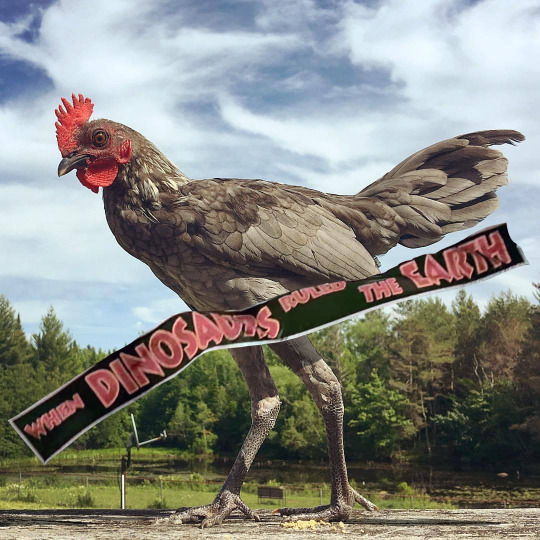
Me, beaming excitedly: Actually, they do! Since by the rules of phylogenetics all descendants of a group still belong to that group, dinosaurs still exist in the form of birds, which first began to evolve from smaller species in the late Jurassic-
@a-dinosaur-a-day, instead of a kulinda riding a utah to victory, a beefy birb who provides a mobile podium for their small floofin friend to spread the good word of floof and science.
Sometimes I remember that there’s a massive beef in the paleontological community between Jack Horner and Robert Bakker and it’s so big that when they both worked as advisers on the Jurassic Park films, Spielberg made 2 characters based on them and had a T. rex eat Bakker’s character as a favour to Horner.
“The bearded paleontologist Dr. Robert Burke, who is eaten by a Tyrannosaurus rex in Steven Spielberg’s film The Lost World: Jurassic Park, is an affectionate caricature of Bakker.
In real life, Bakker has argued for a predatory T. rex, while Bakker’s rival paleontologist Jack Horner views it as primarily a scavenger.
According to Horner, Spielberg wrote the character of Burke and had him killed by the T. rex as a favor for Horner. After the film came out, Bakker recognized himself in Burke, loved the caricature, and actually sent Horner a message saying, ‘See, I told you T. rex was a hunter!’.”
It’s a shame the National Geographic folks couldn’t have shot this thing when it was painted–but here’s the finished standing Quetzalcoatlus. He’s taller than a modern giraffe!


 Plot Designing