no seriously at what point do we stop saying dinosaurs and start saying prehistoric birds?? is it a matter of time?? a matter of species??? SCIENCE SIDE OF TUMBLR PLEASE HELP
We don’t actually know for certain!
It’s all a gradual series of transitional forms, and where we stick the
arbitrary point of “birds start here” depends on on what you consider to
be their defining traits.
Do we define them by having feathers? If we do that, then fuzzy feather-like structures actually seem to go all the way back to the common ancestor of all dinosaurs and pterosaurs – which would therefore make every single member of those groups birds too.
If you’re not into the idea of calling things like Pteranodon and Triceratops “birds”, then maybe we should go more specific and use the presence of pennaceous feathers instead. The kind with quills and barbs that we normally associate with birds’ wings.
Those are at least found only in theropod dinosaurs, except… they’ve been found in ornithomimosaurs, a group well before anything we’d usually say was a “bird”. (And they might go even further back, since there are possible quill knobs known from the carnosaur Concavenator. And then Tyrannosaurus also gets to be a bird!)
Okay, that’s still a bit weird. What about being able to fly?
That at least seems to have happened in Pennaraptora, a group of theropods that includes oviraptorosaurs, dromaeosaurs, Archaeopteryx, and everything else leading to modern birds. So we’re definitely getting much more bird-like in here.
But we don’t know exactly when flight originated. Opinions on whether Archaeopteryx could actually fly go back and forth constantly (the newest research suggests yes) – but some earlier small dromaeosaurs might also have been capable of powered flight. And there’s even the possibility that bird-like flight independently evolved multiple times in different branches of this particular family tree.
It’s a bit of a mess.
Then there’s always Archaeopteryx as the traditional option for “first bird”, but we’ve found so many other similar birdy things by now that’s it’s not actually unique anymore. Pick out any defining “bird” feature in Archie and there’s an older dinosaur with the same trait which then also has to be a bird too.
And so we end up with the most conservative option: Neornithes
(or Aves), the group that contains all modern
birds going back to their last common ancestor. Those are all definitely
unquestionably birds, but…
…Then things like Confuciusornis and enantiornitheans and Ichthyornis don’t get to be birds. And they’re very birdy-looking. If you saw one alive you’d call it a bird.
But if we keep backtracking through the evolutionary tree along everything that still looks like a bird we just end up right back in the pennaraptoran mess again. So that’s not much help either.
A lot of paleontologists still tend to consider “birds” starting at a point just before Archaeopteryx, in a group called Avialae, but there’s also a lot of inconsistency and disagreements. Really you can pick whatever definition you personally like best and just roll with that, because there’s unlikely to be a Definite Official Bird Definition anytime soon.
this is primarily an obnoxious ad for the enamel pin above (pre-order it here, folks!), but I’m gonna use this opportunity to compare Velociraptor to modern descendants, and see how it stacks up!
Velociraptors & cassowaries evolved hypertrophied claws for entirely different purposes – the ‘slashing, killing claw’ of the Velociraptor is a myth, but modern-day cassowaries have the Real Deal, a ice pick-like weapon on their second toe that can grow to 5 inches.
“The inner or second of the three toes is fitted with a long, straight, murderous nail which can sever an arm or eviscerate an abdomen with ease. There are many records of natives being killed by this bird” – ornithologist Ernest Thomas Gilliard
notice how the cassowary has a straight dagger, while Velociraptor has a hook? modern equivalents to Velociraptor’s hypertrophied claw are eagle talons, used for gripping prey & maneuvering in trees. because it was a terrestrial runner, Velociraptor held this tool off the ground to keep it razor-sharp, but modern birds-of-prey (given the luxury of flight) have transformed ALL their talons into the famous Velociraptor sickle claw!
tl;dr turns out the group aves used the last 66 million years to advance their weaponry & out murder-bird their ancestors (sorry Velociraptor!)
Look I know this is a shit post fuelled by staying up too late on my phone and an extended Gd-awful cold from hell but there are absolutely Tons of Large Weird Birds in the Cenozoic and it’s 100% possible to make an awesomebro-style documentary just about dead birds and people who have limited Cenozoic Bird coverage to just Gastornis and Terror Birds are
Cowards
Alright it’s a new day and I’m still ridiculously ill so I’m back with some great candidates for your Awesomebroy Documentaray on Cenozoic Birds and how Freaking Weird They Are
These guys were large, flightless predatory birds with small wings that lived from the end of the Paleocene to the beginning of the Pleistocene in South America (and later on in North America). You could literally pick any time to have these guys running around and wreaking havoc. You can EVEN HAVE THEM FEEDING ON OTHER BIRDS like this Strong!Rhea below
They are actually closely related to Terror Birds but they lived in North America from the Eocene to the Miocene, and they were also large, long-legged predators of other food. The main difference is basically range and the fact that they had longer wings – most of them were still flightless but some of them could still fly which is terrifying
While I’ve got you here with Cariamiformes aka Seriemas and their weird-ass dead relatives we also have things like Strigogyps and Idiornis which were essentially like modern seriemas but smaller and all over the place during the Paleogene, and also mother-fucking qianshanornis that had a fucking SICKLE CLAW LIKE A DROMAOESAURID RAPTOR this was basically a PALEOCENE DROMAEOSAUR except a Neornithine bird
this illustration by Apokryltaros doesn’t do it justice but I work with what I’ve got
If Seriemas and their compendium of terrifying dead cousins don’t tickle your fancy just fucking wait I’ve got more
The Gruiformes aka Crakes Cranes and Rails and shit were weirdly morphologically diverse back in the day and they did more than Wade in the Water
Eogrus and its relatives were essentially Crane Ostriches they also only had two toes and were probably built mainly for running they lived from the Eocene to the Pliocene in Eurasia and all I have to work with again is bad wikipedia illustrations but here it is the freaking weirdo
By Tim Morris
But wait! There’s also the Adzebill!!!!!
By Nobu Tamura
These were ALSO large flightless relatives of modern cranes and they were JUST in New Zealand from the Miocene to RECENT TIMES aka the Holocene and they had long pointy beaks so they could hunt for small animals like lizards and tuatara and OTHER BIRDS in their habitat and they WEREN’T the only large birds in New Zealand because New Zealand is essentially DINOSAUR LAND 2: THE FEATHERING cause it was isolated from mammals apart from bats until humans showed up and ruined everything so we have
By Jack Wood
Haast’s Eagle, one of th elargest known flying birds that hunted
Freaking Moa, the large flightless ratites that basically were the Charismatic Megafaunal Herbivores of New Zealand and they lost their wings and looked so trippy but also so cool and they were HUNTED ON BY GIANT EAGLES
By John Megahan
I just. Have some. Some important. Questions. WHY THE FUCK HAVE I NEVER SEEN THIS MAGICAL LAND IN A MAJOR DOCUMENTARY. There were also a bunch of really cool other birds in New Zealand that are pretty unique to New Zealand (and some of them are still around today like New Zealand Wrens and The Kakapo!) but I’m trying to stick to charismatic megafauna type shit for this list the whole point is that you can make an AWESOMEBROY documentary JUST ABOUT CENOZOIC BIRDS very easily anyway
Speaking of large flightless ratites we also have the Elephant Bird from Madagascar which I NEVER SEE TALKED ABOUT except for like the context of “largest bird” which for the record it might not be I don’t have a good skeleton of it but there were lots of different kinds of Elephant Birds in Madagascar and they were basically the large herbivores of the area doing their thing and There is ALSO Eremopezus which was a large flightless bird from the end of the Eocene so an EARLY ONE and we have NO IDEA what kind of ratites it was closely related to or even if it IS a ratite and it would have been a ridiculously large bird and STAY TUNED FOR MORE OF THAT MYSTERY
There are also, of course, ratites in the Cenozoic – such as the Emuary, which is literally just an early relative of both Emus and Cassowaries thats a cross between the two, lots of extinct Ostrich and Rhea relatives – like the Strong!Rhea above and of course various ostriches that spread all over the Eastern Hemisphere, and the Lithornithids!
LITHORNITHIDS 👏DESERVE 👏MORE 👏PRESS 👏 THEY 👏WERE 👏PERCHING 👏RATITE-COUSINS 👏THAT FLEW AND SORED 👏ALL OVER THE EARLY PALEOGENE 👏👏👏👏👏👏I’M VERY BITTER
SPEAKING of Bitterns and their relatives (ha ha I’m hilarious) we DO HAVE dead shoebill relatives from Egypt called GOLIATHIA and there are also GIANT. IBISES. GIANT IBISES. FLIGHTLESS, GIANT IBISES. Called the Jamaican Ibis.
And I hear you, by this point you might be saying “but like, the hallmark of any discussion of Cenozoic fauna is talking about the evolution of whales which is a Trip and there isn’t an analogous thing in birds is there” and I hear you. I hear. you. My counterpoint is: the evolution of PENGUINS
By Nobu Tamura
THEY WENT FROM FLIGHTED SMALL BIRDS TO LOON-LIKE-THINGS (note: penguins are NOT CLOSELY RELATED TO LOONS) to WEIRD LARGE BIRDS WITH LONG SHARP BEAKS GOOD FOR STABBING –
WE EVEN KNOW THE COLOR OF SOME OF THEM (by Apokryltaros)
AND. THEY. GOT. FUCKING. H U G E (size comparison by Discott)
They aren’t the only dead birds that got to look like that though. There were other very aquatic birds back in the day – like the relatives of modern Boobies from Japan, the Plotopterids – they lived rom the Eocene to the Miocene, they were huge, and they were the “Northern Hemisphere’s Penguins”
By Nobu Tamura
And of course we can’t forget the Great Auk which is literally named Pinguinus and needs No Introduction
By Mike Pennington
Okay while we’re on the subject of large aquatic birds HAVE YOU HEARD OF THE SWIMMING FLAMINGOS
By Ghedoghedo
THESE GUYS WERE BIG. THESE GUYS WERE LONG. THESE GUYS WERE FREAKY LOOKING. THESE GUYS HAD SHARP STABBY BEAKS. AND THEY LIVED FROM THE OLIGOCENE TO THE PLIOCENE AND ARE A WEALTH OF WEIRD FREAKINESS AND MY ONLY REGRET IS THAT I DON’T HAVE A RECONSTRUCTION FOR YOU.
Oh wait while we’re talking about flamingos have I MENTIONED THE DUCKS THAT EVOLVED TO BE WEIRD FLAMINGO-MIMICS
THIS IS TEVIORNIS (by @thewoodparable) FROM THE CRETACEOUS BUT IN THE PALEOGENE THEY GOT EVEN WEIRDER AND SKINNIER AND FLAMINGO-Y-ER BUT WITH DUCK BILLS INSTEAD OF THE HOOK THINGS OF FLAMINGOS AND THEY MIGHT HAVE LIVED ALL THE WAY UNTIL THE OLIGOCENE –
THIS IS WILARU ITS FROM AUSTRALIA AND IT WAS MORE TERRESTRIAL AND VERY STRONG/ROBUST IT WAS A BIG BOY
Okay, okay. I know what you’re thinking. You heard me mention Ducks and you think I’m holding out on you. Fine. Fine. I have neglected to mention the only reasonably famous Cenozoic Bird.
Yes, there’s Gastornis. And while I probably would say “nope, we don’t need that, it’s been in everything,” I will acknowledge that to my knowledge it has never been represented as it was IN LIFE. We USED to think these weirdos were large predatory birds in their habitats like the Terror Birds would one day be.
TURNS OUT WE WERE WRONG.
Gastornis and its relatives were actually HERBIVORES. Giant, flightless, convergent-on-PARROTS-HERBIVORES. They would USE THEIR GIANT BEAKS TO BREAK OPEN FRUIT. THEY WERE WEIRD CASSOWARY-PARROT-DUCKS and SHOW THEM THEIR PROPER RESPECT.
They also weren’t the only LARGE FLIGHTLESS DUCK THINGS
By Nobu Tamura
DROMORNIS AND ITS RELATIVES may or may not be closely related to Gastornis we don’t actually know and they were Australian and Huge and they lived from the Oligocene to the Pleistocene and they were ALSO herbivores and they ALSO had tiny wings and they were ALSO huge and there were more of them than there were of Gastornis and they ALSO were probably like parrots in cracking open fruit and other things with their huge beaks and even though they were fairly robust they could still run fast using the power of BRUTE STRENGTH
BRUTE STRENGTH RUNNING
Also let us PLEASE not forget the gaggle of Quaternary-period Large Flightless Goose-like Ducks from Hawai’i because these guys were AWESOME, WEIRD and in a lot of ways very cute and worth mentioning. They also had fun names like Small-Billed Moa-Nalo, Ptaiochen –
And Thambetochen –
And my personal favorite, the Turtle-Jawed Moa-Nalo, which not only is adorable, but has an absolutely ridiculous genus name – Chelychelynechen
like
why
All illustrations of these weirdos are by Apokryltaros
And in the realm of waterfowl, ALSO don’t forget that there was an Island off the coast of Italy with TINY ELEPHANTS but more importantly GIANT SWANS OF DOOM THAT WOULDN’T HAVE EATEN THEM BUT WOULD HAVE CHASED THEM AWAY BECAUSE, LIKE ALL SWANS, THEY WERE ASSHOLES
The teratorns were relatives of New World Vultures aka things like Condors; they lived in North and South America from the Oligocene to the Pleistocene (so you can absolutely have a Terror Bird eating the carcass of a Rhea while a Teratorn circles overhead looking for nibbles) and they were huge, soaring animals with impossibly large wingspans and we have tons of fossils of these guys including from the LA BREA TAR PITS so there’s THAT for charismatic localities
By Nobu Tamura; TERATORNS
By the way there are a lot of birds from La Brea not just Teratorns there are tuns of Eagles and Vultures (including Old World Vultures which were in the New World until humans got there basically so that’s an interesting Thought) and Ducks and Sea Birds and Giant Storks –
By Ellen
And pigeons and Caracaras and turkeys and songbirds and woodpeckers and grebes and egrets and cranes and owls –
By Apokryltaros
OH CRAP OWLS
OWLS
O W L S you guys
First off I find it very important to note that we actually have a halfway decent evolutionary sequence for owls
By Ghedoghedo
but BEYOND THAT we have the RIDICULOUS STILT HOWLS that were the largest owls to ever exist and they were probably flightless and they lived in places like Cuba and they had long legs and were very strong and they probably could run around like maniacs and they were basically convergent on seriemas? I’d say?
By Apokryltaros
Like what the fuck. What the. Fuck. Fucccck. Fuck.
While I have you here with birds of prey hav eyou heard of the Flexiraptor?
The Flexiraptor, or Pengana, is basically a cross between a Secretary Bird and a Caracara (though it’s most closely related to thinks like Eagles and Hawks) from Australia in the Miocene (actually, it’s from Riversleigh, which has lots of other really good birds like early modern-ish parrots and passerines and stuff) and it had feet that were as flexible as like, human hands, which let them reach into holes and crevices to grab prey, which is freaking awesome, go Flexiraptor
Also, may I remind you that the earliest parrots were birds of prey
These birds were small but had parrot feet and beaks built for grabbing other animals and CRONCHing them. PARROTS OF PREY.
Finally. The thing you’ve all been waiting for. The birds that are a CRIME that I’ve never seen them in a single documentary thing and as far as I’m aware the only attempt to represent them in media has been in fucking Ark: Survival Evolved.
The Pseudotoothed Birds.
By Didier Descouens
ARGHHHHH WHY HAVE THESE NEVER BEEN SHOWN IN ANYTHING
PSEUDOTOOTHED BIRDS WERE RIDICULOUSLY COMMON BIRDS THROUGHOUT THE ENTIRE CENOZOIC
THEY ONLY WENT EXTINCT RECENTLY
THEIR MOUTHS LOOK LIKE SOMETHING OUT OF A HORROR FILM
We have NO IDEA what these guys were related to, they were most definitely sea-birds though but they might be closely related to ducks or they might be closely related to modern seabirds we really just don’t know, and they were everywhere – North America, Europe, Africa, Asia, South America, New Zzealand, EVERYWHERE. EVERYWHERE AND EVERYWHEN. they only went extinct 2.5 MILLION YEARS AGO. They also had RIDICULOUSLY LONG WINGS
By Ryan Somma
THEY WERE ALSO SOME OF THE LARGEST FLYING BIRDS WE KNOW OF
FREAKING. HUGE. SOARING. MONSTROSITIES OF TERROR.
By El Fosilmaníaco
Just. Just picture. You’re an early Hominid. On the beaches of Africa. Staring out at the sea. And you see a bird. That looks like a normal seagull or something. Just normal. And then you look closer.
By Jaime A. Headden
AND YOU SEE THE DEMON SHARP PROJECTIONS OF THE BEAK THAT TO YOUR LESS MODERN BRAIN WOULD HAVE LOOKED EXACTLY LIKE TEETH
YOU RUN
YOU FUCKING RUN
For FUCKS sake. WHY. They used the teeth to snag fish but WHY.
And, of course, there were lots of paleo environments with lots of different types of birds showing how they diversified and first evolved and what kinds of birds there are – the Messel Pit, Fur Formation, and Green River Formations all have LOTS of birds and are great windows into the Eocene Radiation of birds.
And of COURSE there are a lot of SMALL BIRDS that are really interesting and show how birds diversified during the Cenozoic and they’re really cool but THE POINT OF THIS POST IS THAT THERE ARE A SHITTON OF
CHARISMATIC AVIAN MEGAFAUNA
and ANYONE WHO LIMITS THEMSELVES TO GASTORNIS AND TERROR BIRDS when talking about birds in the Cenozoic
IS
A
COWARD
thank you for coming to my Ted Talk
If I missed anything let me know because not only do these things not get the coverage they deserve in popular representation they also have fucking terrible online resources and thank g-d Gerald Mayr exists because without him we’d all be lost
So… what would happen if Cretaceous wildlife had somehow survived into 18th century France?
This is my “master copy” of Jean-Baptiste Oudry’s works! Oudry was a well-known Rococo artist who was frequently commissioned to paint the king’s treasured hunting dogs. I had a ton of fun replacing the loyal dog with a pair of mischievous dromaeosaurs! I tweaked a bunch of other details to make the painting a little more Mesozoic-appropriate, too.
Yeah, I can see how this creature was the ancestor of modern birds …
I hate to be that person (no I don’t, I love it) BUT this is Yutyrannus huali, a tyrannosauroid, and birds are not a direct descendent. tyrannosaurs & birds are groups that parted ways in the Jurassic (birds shrank, developing wings capable of flight, while tyrannosaurs ballooned up into gigantic carnivores).
now this guy below? that’s Sapeornis, a stem-bird that lived in the early Cretaceous, around the same time as Yutyrannus – look at how clearly those two groups had diverged by then!
descendants of guys like Sapeornis survived the K-T extinction event, as it turns out being small, able to fly long distances, with a toothless mouth perfect for taking advantage of seed caches is just the right formula for surviving a sunless ash-filled Apocalypse
and yes, they went on to become chickens, but also golden eagles, maribou storks, birds of paradise, cassowaries, penguins, hummingbirds, owls, you name it. in terms of sheer diversity of species, living dinosaurs still vastly outnumber us mammals (16% of modern vertebrates, vs our measly 8%)
happy Friday everybody, it’s time for another installment of Weird Biology! and today, you’re going to learn about a goddamn dinosaur.
(yes, I know all birds are technically dinosaurs, but this one is… dinosaurier? dinosaurien? DINOSAURIEST than the rest)
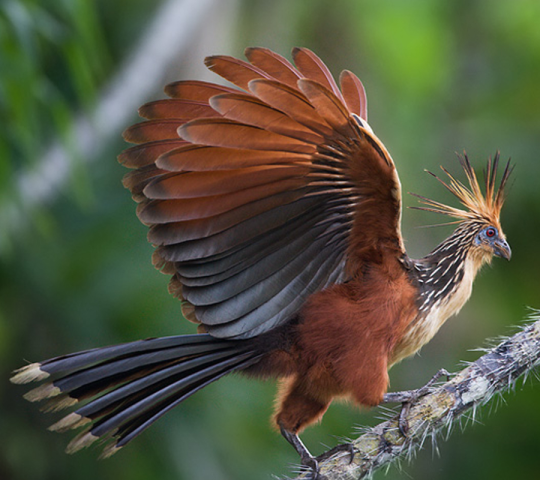
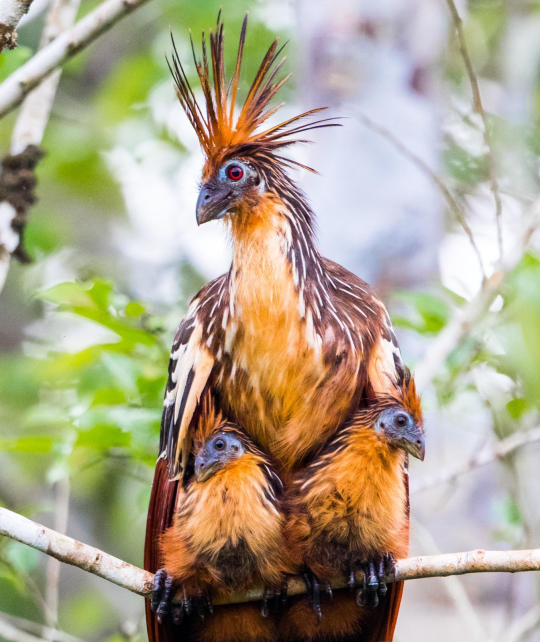
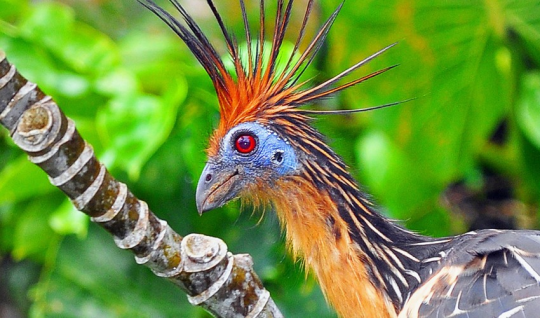
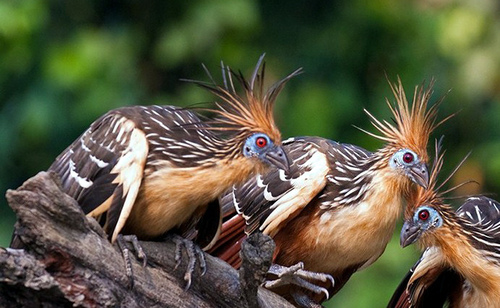
meet the Hoatzin, relic of ages past
*raptor screech*
the Hoatzin is the only member of the family Opisthocomidae, an ancient line of birds that branched off from the rest some 64 million years ago. this would have been just shortly after the event that murdered the shit out of all non-avian dinosaurs. to death.
Hoatzins are the very last survivors of this ancient line. (I wanted to make a joke here, but that’s actually really fucking tragic)
shit I made myself sad, MORE JOKES
Hoatzins are common pheasant-sized birds that live in the riverside forests of South America, where they survive on a diet of *drumroll* leaves. yum.
seriously, they are one of exactly two known bird species to specialize in leaf-eating, having evolved past their shame trait some 30 million years ago. (the other one is the Kakapo, who mostly just seems confused)
Kakawho?
their love of delicious delicious leaves gives them a very… distinctive odor, shall we say. this is due to their fermentative digestive process. it has earned the Hoatzin the local name ‘Stinkybird”, which for any Hoatzins reading this, is really more of an affectionate nickname. honest.
but what truly sets Hoatzins apart, and proves their saurian nature, is this.
HOLY SHIT A DINOSAUR
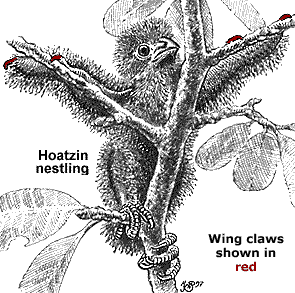
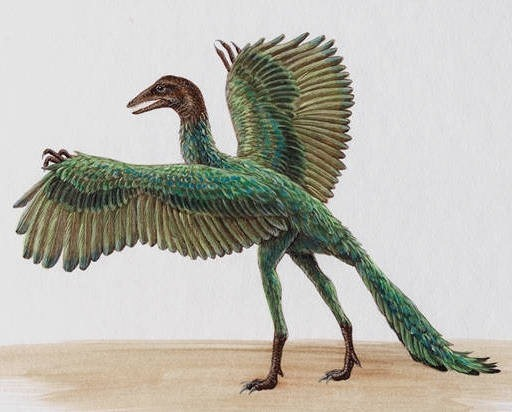
the hatchlings have fucking claws on their wings. remind you of anything? like maybe, oh I dunno, this guy?
HOLY SHIT A BIRD
Archaeopteryx up there bears a striking resemblance to our Hoatzin friend, which did not go unnoticed by the scientific community (who was actually paying attention this time, they swear). in fact, this uncanny resemblance helped finalize the theoretical link between dinosaurs and birds, which we now know are the same fucking thing. (more or less)
but anyway, the baby Hoatzins use those scientifically-groundbreaking claws to scramble around in trees and avoid predators. also apparently the claws just kind of… fall off?.. when the bird becomes an adult. like, imagine if your fingers all fell off at puberty, how weird would that be? jesus.
(Hoatzins definitely aren’t the only birds with wing claws, but DON’T TELL THEM THAT. they like to feel special.)
thankfully, it looks like these evolutionary weirdos will be with us for some time to come, as Hoatzins continue to be plentiful in their range. we hope they and those weird dinosaur claws stick around for a long, long time.


 Plot Designing