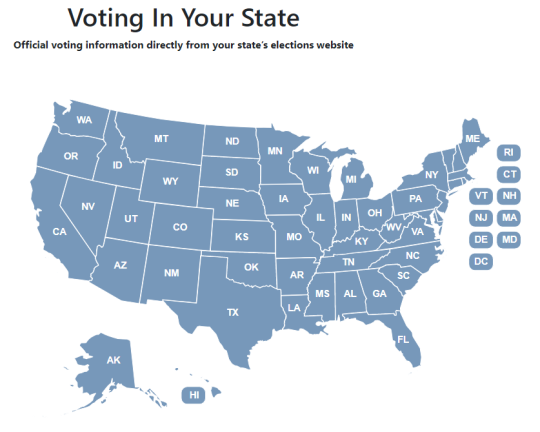
Hank Green + his friends made a whole YouTube channel dedicated to videos explaining how to vote in every. single. state. None of them are longer than three and a half minutes. Deadlines to register are fast approaching in a lot of places so it’s incredibly important that everyone is well informed about what they need to do in order to exercise their right and make their voice heard. Go forth, America. Show up for what you believe in. Make good choices. Please.
Literally nothing you do is safe from the CIA. There are numerous full-on spyware suites developed by them, mostly for iOS and Windows, but also targeting Android, Linux, OS X, and Solaris. Apps thought to be secure (Telegram with encryption enabled, WhatsApp, Signal) were compromised as well, as were a host of other devices (ie smart TVs).
THIS DOES NOT PERTAIN ONLY TO AMERICANS.
If you live in a Shengen area country, your country likely hosts several CIA backed cyberwar experts. They came in via the US consulate in Frankfurt. If you don’t, you likely do as well, but I can’t find anything without sifting through the files myself.
“I have nothing to hide, why does this matter?”: Because there are now multiple thousand “zero hour”- ie “developers get zero hours to fix”- vulnerabilities floating around that no one had any idea existed. The vulnerabilities themselves weren’t leaked, but it’s the fact that someone knew about these and didn’t say.
I hate to make this kinda clickbait-y thing, but this is honest to God one of the most important leaks in history. Our response to this is pretty much going to be life or death for privacy in the developed world. Be loud about this, be annoying about this, and do not shut up about this. Please reblog this and other posts relating to it.
Not just any someone, this is one of the U.S. federal government’s foremost intelligence agencies, the CIA, which even mainstream media has reported operates on a black (off the record) budget, infamous for handing over “full” reports that are almost entirely redacted.
It’s a wonder that anyone out there could believe they are not the subject of surveillance—everyone has something to hide.
The USA can access personal email, chat, and web browsing history. (Source)
The USA tracks the numbers of both parties on phone calls, their locations, as well as time and duration of the call. (Source)
The USA intercepts troves of personal webcam video from innocent people. (Source)
The USA is working to crack all types of sophisticated computer encryption. (Source)
The USA monitors communications between online gamers. (Source)
The USA can set up fake Internet cafes to spy on unsuspecting users. (Source)
The USA can remotely access computers by setting up a fake wireless connection. (Source)
The USA can use radio waves to hack computers that aren’t connected to the internet. (Source)
The USA can set up fake social networking profiles on LinkedIn for spying purposes. (Source)
The USA undermines secure networks [Tor] by diverting users to non-secure channels. (Source)
The USA can intercept phone calls by setting up fake mobile telephony base stations. (Source)
The USA can install a fake SIM card in a cell phone to secretly control it. (Source)
The USA can physically intercept packages, open them, and alter electronic devices. (Source)
The USA makes a USB thumb drive that provides a wireless backdoor into the host computer. (Source)
The USA can set up stations on rooftops to monitor local cell phone communications. (Source)
The USA spies on text messages in China and can hack Chinese cell phones. (Source)
The USA spies on foreign leaders’ cell phones. (Source)
The USA intercepts meeting notes from foreign dignitaries. (Source)
The USA has hacked into the United Nations’ video conferencing system. (Source)
The USA can spy on ambassadors within embassies. (Source)
The USA can track hotel reservations to monitor lodging arrangements. (Source)
The USA can track communications within media organizations. (Source)
The USA can tap transoceanic fiber-optic cables. (Source)
The USA can intercept communications between aircraft and airports. (Source)
And this leak shows that the CIA has all of these technologies and proliferates them to other entities who want this information all the time. You need your privacy to protect yourself and your information. If you have nothing to hide, you have plenty to hide:
The line “if you’ve got nothing to hide, you have nothing to worry
about” is used all too often in defending surveillance overreach. It’s
been debunked countless times in the past, but with the line being
trotted out frequently in response to the NSA revelations, it’s time for
yet another debunking, and there are two good ones that were recently
published. First up, we’ve got Moxie Marlinspike at Wired, who points
out that, you’re wrong if you think you’ve got nothing to hide,
because our criminal laws are so crazy, that anyone sifting through
your data would likely be able to pin quite a few crimes on you if they
just wanted to.
Some of the potentially sensitive facts those records expose becomes
obvious after giving it some thought: Who has called a substance abuse
counselor, a suicide hotline, a divorce lawyer or an abortion provider?
What websites do you read daily? What porn turns you on? What religious
and political groups are you a member of?
Some are less obvious. Because your cellphone’s “routing information”
typically includes information about the nearest cell tower, those
records are also a kind of virtual map showing where you spend your time
— and, when aggregated with others, who you like to spend it with.
We simply cannot possibly know when something is going to incriminate us and the State is not above scapegoating individuals or coercing them into submission. James Duane, a professor at Regent Law School and former defense attorney, notes:
Estimates of the current size of the body of federal
criminal law vary. It has been reported that the Congressional Research
Service cannot even count the current number of federal crimes.
These laws are scattered in over 50 titles of the United States Code,
encompassing roughly 27,000 pages. Worse yet, the statutory code
sections often incorporate, by reference, the provisions and sanctions
of administrative regulations promulgated by various regulatory agencies
under congressional authorization. Estimates of how many such
regulations exist are even less well settled, but the ABA thinks there
are ”nearly 10,000.”
The complexity of modern federal criminal law, codified
in several thousand sections of the United States Code and the virtually
infinite variety of factual circumstances that might trigger an
investigation into a possible violation of the law, make it
difficult for anyone to know, in advance, just when a particular set of
statements might later appear (to a prosecutor) to be relevant to some
such investigation.
Not just the State, but anyone could draw suspicion against you if they had the right information with the right circumstances. We are entitled to our privacy, and these institutions must be held to account.
Reblogging because the links in the bulleted list were broken, as someone brought to my attention.
“Those results would reveal that 83 percent of black and 66 percent of Latinx voters believe Blasey Ford, compared to a mere 40 percent of white voters. And that 80 percent of black and 69 percent of Latinx voters considered her honest compared to just 54 percent of white voters.
This gap persists even when you isolate out white women, a demographic some pundits believed would be outraged at how Blasey Ford was treated by Senate Republicans (her testimony—deemed “credible” by Republican members of the Senate Judiciary Committee—was essentially thrown out once Kavanaugh began rage-crying).
According to the Quinnipiac poll, nearly half (47 percent) of white women considered Kavanaugh to be honest. The numbers for black and Latinx voters? Just 7 and 34 percent, respectively. A plurality of white women did believe Blasey Ford (46 percent)—but it was nowhere near the majority, as was the case with black and Latinx voters.
Parsing out this data matters, because if journalists don’t, they can misleadingly run with narratives like the one in a recent article from the AP, which boldly declared in the headline: “Many women line up in support for Kavanaugh.”
In other words, the exact same breakdown as the ‘16 election.
First off, this is not a political post. This is a scam awareness post. Hopefully people help spread the message, considering this is US Voter Registration Day according to today’s Google doodle. You also don’t have to spread this entire post to be helpful, just the two links at the end. I apologize it’s long, it could be as short as “don’t use TurboVote, they give your information to multiple partners who bolster their company value with it, FOR THE LOVE OF CHRIST, IGNORE THE TWITTER NOTIFICATION YOU WILL RECEIVE.”
But I also don’t want it to appear as some low-effort grab for attention. This is the kind of thing that needs lots of proof and explanation. People are exploiting the current political environment to scam young Internet users into giving away swathes of personal information to access services that shouldn’t require anything more than a ZIP code.
This one is particularly bad.
Because it will affect millions.
This evening, I got an odd sponsored post on my Twitter feed. It appeared as so:
I’ve seen sponsored links like this before. A large corporation like Twitter would create expedited guides to help their users participate in their national elections, but would also collect this information for figuring out voter behavior and trends. These would then be offered to the political parties so they know where to focus their efforts better. It’s a pretty basic business.
But the thing that caught my attention was that upon following the link, I was immediately asked to fill out personal information.
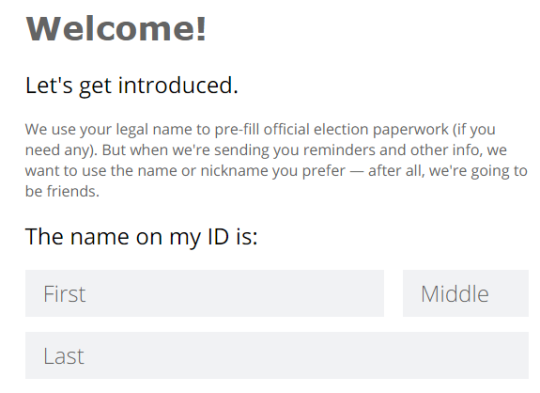
The landing page takes you here:
“After all, we’re going to be friends.”
Somebody actually approved that copy. Because that’s not creepy or anything.
Already, they are asking for your first and last name. Note that online registration for voting is legal in 39 states, so the first check should be to confirm if the user is even able to utilize the service. Also, to help direct me to a verified site that would be able to process my voting application, it wouldn’t need to know my first or last name, it would just need to know what State I resided in.
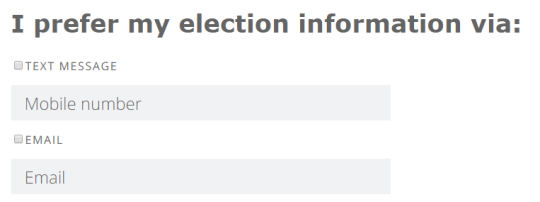
The next page gets worse.
I cropped out a lot of text in between, but basically, the next page doesn’t waste any time asking for even more personal direct methods of contacting me. Probably for “special offers” and “updates” from sponsored candidates and action committees buying their way into my inbox.
They’ll surely ask for my State to get the actual process underway, yes?
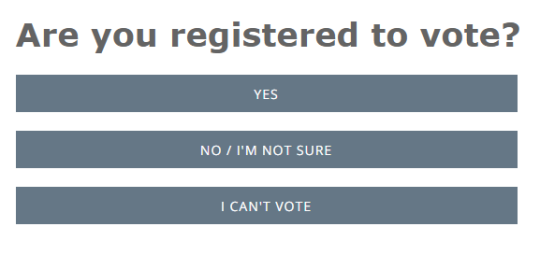
Nope. Next page is just me confirming that I am a live and active recipient of their “services.” Note they already have my name and Email/phone number, so selecting “Yes” would automatically put me on their recipient list to be pestered. But what’s interesting is if you select “No/I’m Not Sure”…
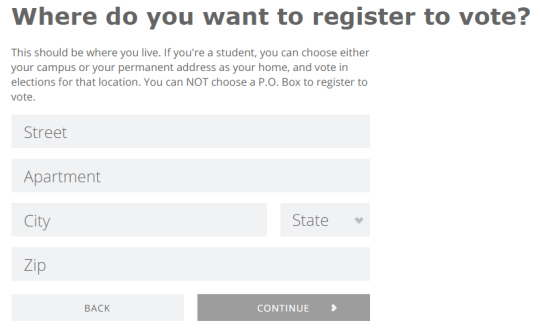
Hey, there’s the State pull-down menu! But it’s with…ehh, a lot of very personal information that’s definitely not needed to verify if I’m eligible to vote, or to redirect me to an official government source to actually register.
Let’s put in some fake credentials. Note I’ve been using a browser with cleared cache and incognito mode, so it can’t siphon off my browsing history to circumvent my trickery. I am also using a VPN, so they can’t figure out my location either.
Now I’m very concerned.
So I’m not filling in an application at all. As speculated. I’m just giving a whole bunch of extraneous information, and after giving them my name, my phone number, my Email, my street address, and my current voting status, I’m simply provided with links to the actual government resources and registration page.
I’ll register online.
I get kicked back to the landing page. The link does not work. Everything I sent in just returns me to a “null” subdomain.
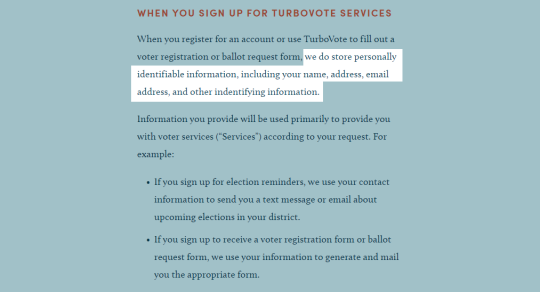
Alright so this is very suspicious. Who the heck even are these guys? Let’s check the privacy policy.
Confirmation that they do store all the information you sent them. However, they assure that it’s not sold.
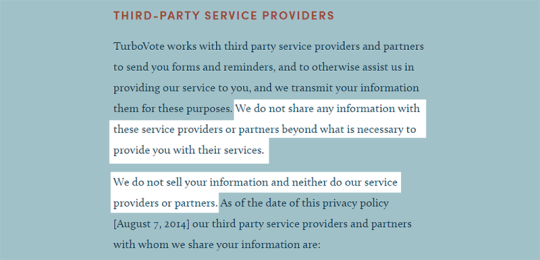
They also claim that their partners do not sell the information either, and they are only given that information simply to perform the services they use.
Unfortunately…
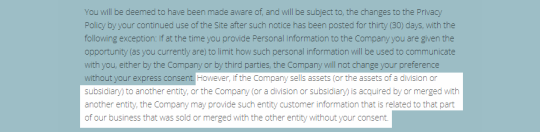
What curious findings have we here?
Basically, the company is not going to delete its databases of user information if they’re purchased by another entity. Not even the entire company, just a “division or subsidiary” of the company, like the “database of their collected addresses and user names” division.
Don’t be fooled.
TurboVote is exploiting National Voter Registration Day to data mine you. They claim neither they nor their partners sell user information, but they do collect it, store it, and they will hand it over if an interested party decides to purchase it. Not TurboVote directly, but their “partners” will. They accumulate it, all the while saying they aren’t selling it, and what’s deceptive is they’re telling the truth, it’s not being sold. That is…until they put themselves up for sale, and use that gigantic address book to bolster their company value through the roof.
You don’t have to do this. They do not need your home address to relay you to your registration form. They don’t need to keep your information stored on file. They don’t need your name, your voting eligibility, your party affiliation…any of that information. DO NOT give your personal information to third-party “voter assistance” scams like this. It’s absolutely abhorrent that Twitter is sending mass notifications to people to use this data mining service, when there are plenty of simple non-committal websites already in existence to provide you the services you need.
And remember. Please vote. If you’re confused about ballot measures and local election information without the hyperbolic nonsense blasting out of the TV ads, and wish there was some sort of Ballot-type Wikipedia site out there, Ballotopedia is a fantastic source that lays out all the information you need for every ballot out there. Even you, Mr. Ezekiel Zebadiah Abraham of Muttonbutt County, Kentuckabama, they’ll even have comprehensive guides to help justify re-electing Officer Fuzzwhistle The Cat for his fifth term as mayor.
Again, I’m fully aware this is such a long post. Hopefully this helps you guys figure out how to get involved in the legislative process, and moreso, provides you the links necessary to give actual help to others without compromising their security. You don’t have to send them this post (please don’t, it’s gigantic), just the alternate site suggested at the end.
Thanks.
Hey, Twitter, this is how the Russians get their info.
I don’t think I have any mutuals in Florida, but if anyone else does, pass this along. Probably important to be aware of these issues when voting by mail in other U.S. states, too.
I’ve been voting by mail all my adult life, because I registered during the Bush years, when “hanging chads” in the state where one of the candidate’s brother was governor were one of the reasons he was allowed to win, and there was a lot of concern about the security of voting machines (which has NOT improved). Voting by mail has definite benefits, but cast your ballot early, and make sure it counts.
check your signature and your ballot date and follow up!
My favorite professor ever introduced me as an undergrad to the concept of “impossible history” – histories that can not exist, even though they happened. His example was the Haitian Revolution. The Haitian Revolution cannot exist within the logics of capitalism, imperialism, and white European dominance. Enslaved black people liberating themselves without the help of “friendly whites?” A tiny island in the Caribbean, with an army of the aforementioned former slaves, defeating multiple global superpowers? Impossible! So this cannot be allowed to have happened. Haiti must be economically victimized forever, moreso even than other former slave colonies in the Caribbean, just so that we can point to it and say “look, how sad,” so that no one gets to see Haiti’s very existence as the triumph it is. We teach extensively about the American and French revolutions, but only mention in passing the Haitian Revolution which occurred at the same time. Most college courses on Latin American history exclude Haiti even if they cover the rest of the Caribbean. The Haitian Revolution was impossible, a dangerous fantasy that just so happens to have actually happened. So it must be forgotten, the name of Haiti must be made synonymous with poverty, ignorance, and suffering, while never mentioning that those are all the products of 200 years of political and economic warfare and subterfuge against the island, beginning with the presidency of Thomas Jefferson!! Because we cannot have anyone thinking that even the most poor and downtrodden people. when united and organized around a common cause, can make history and change the world for the better
This is the thesis of Michel Trouillot’s book, ‘Silencing the Past’. I am sure that’s where this professor got this from.
Yep! Sorry, I just wrote this post as a ramble and didn’t expect it to spread much. The professor who relayed this to me is Alexander Aviña, a fantastic historian of Mexican radicalism who teaches at Arizona State now
One (of many) examples of how they were screwed over, from wikipedia
“Haiti’s legacy of debt began shortly after gaining independence from France in 1804. In 1825, France, with warships at the ready, demanded Haiti compensate France for its loss of slaves and its slave colony. In exchange for French recognition of Haiti as a sovereign republic, France demanded payment of 150 million francs. In addition to the payment, France required that Haiti discount its exported goods to them by 50%.[3] In 1838, France agreed to reduce the debt to 90 million francs to be paid over a period of 30 years to compensate former plantation owners who had lost their property.[4] The modern equivalent of $21 billion was paid from Haiti to France.[5]
I am Part of the Resistance Inside the First Order
An opinion piece
for the Galaxy Times that was definitely not written by General Hux
The Core World journalism clique immediately figures out it’s him because he uses the word “loathsome” and going back over his speeches it’s kind of a linguistic tell.
Slate today is taking the rare step of publishing a letter someone sent us from inside an ongoing bank robbery. We have done so at the request of the author, who is currently robbing a bank, but would like to minimize his exposure to criminal charges from this whole bank robbery thing now that it seems to be going south. We invite you to submit a question about this essay or our vetting process here.
“Machine Gun” Bill McGuire, the leader of the gang of hardened criminals currently robbing the First National Bank, is facing a test to his leadership unlike any faced by a modern American bank robber.
It’s not just that the building is surrounded by police officers. Or that he’s running out of hostages to bargain with. Or even that the sentries he posted in the loading dock don’t seem to be responding over their walkie-talkies anymore.
The dilemma—which he does not fully grasp—is that many of the senior henchmen inside his own gang are working diligently from within the bank to paint ourselves as heroes in the press while continuing to stuff our duffel bags with as much money as we can grab.
I would know. I am one of them.
To be clear, ours is not the popular “police department” of the government, the one that enforces the laws against robbing banks. We want the robbery to succeed and think that the part where we made the bank clerks hand over all the money in their drawers at gunpoint was a step in the right direction.
But we believe our first duty is to make it out of the bank alive so we can spend the money we have stolen, and “Machine Gun” McGuire continues to act in a manner that is detrimental to our escape.





 Plot Designing