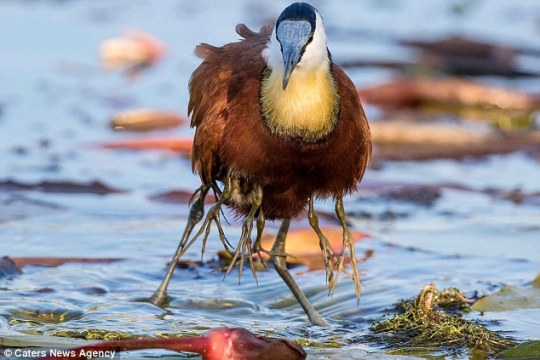
It’s a baby Jacana. They use those ridiculous stick-figur toes to evenly distribute their weight as they walk around on waterlillies and stuff. Like snowshoes, but for swamps.
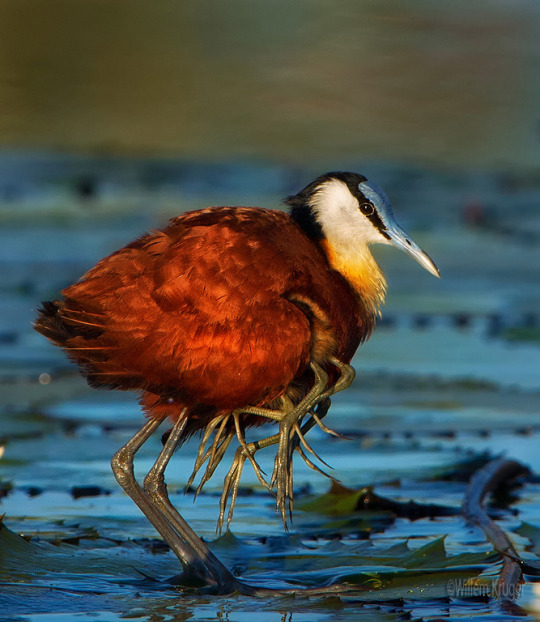
Here’s an adult:
Another really interesting thing about Jacanas is that it’s the dad who does all the child rearing while mom goes off to lay more eggs. Amd their really good dads too! Plus look at how they Cary their babies around!:
Referred Species: D. novaehollandiae (Emu, extant), D. ocypus (extinct)
Now we’re on to our final ratite – remember, Cassowary was done earlier (but I’ll reblog the post soon) – the Emu! The Emu is an Australian ratite that is not endangered – and, indeed, is found all over Australia today and oftentimes in many zoos. It’s also often tamed and reared for food, feathers, leather, and oil, and even can be reared as pets (though, don’t do that lightly, talk about a high-maintenance dinosaur).
Current range for Emus, by Sémhur, CC BY-SA 4.0
The first fossil record of emu relatives appear in the Miocene, though these early fossils known are not able to be given their own name. These remains come from the Waite Formation and the Camfield Beds Formation of Australia, dating to as old as 16 million years ago, in the Burdigalian of the Miocene. Of definable species, one extinct species is known, D. ocypus, from the Pliocene. Many extinct subspecies are also known – such as the Kangaroo Island emu, which was significantly smaller than current emus and went extinct due to human activity. The King Island Emu was also smaller than the mainland Emu and also went extinct due to human activity, as did the Tasmanian Emu subspecies.
Size Comparison of the Mainland Emu (center) and the King Island Emu (right), with a person (left), by Tim. H. Heupink, Leon Huynen, and David M. Lambert. CC BY 2.5
Today, the Emu is the second tallest bird in the world, right after the Ostrich. they can be between 1.5 and 1.9 meters in height, and between 1.4 to 1.64 meters in length. Females are usually bigger and wider in the butt region than the males. They still have wings, though vestigial and rarely seen, and the wings have small claws at the tip. They have long necks that honestly are longer than you probably have given them credit for, and long legs, and they’re able to run at 48 kilometers per hour, facilitated by their three very well defined toes on their feet. They have extremely strong pelvic muscles as well which gives them strong walking and running abilities.
By FunkMonk, CC BY 3.0
Emus have pale blue necks and heads with dark, shaggy, and thin plumage on their neck and head. They have long, shaggy brown feathers throughout the rest of the body, with unique double-rachis feathers. Each sex looks similar to each other. They can vary the exact brown spotting and patterning in their plumage to resemble their environment, giving them good camouflage, and they change their plumage color depending on environment. Since they live in a variety of regions including arid habitat, savannah, woodlands, and even near human areas, as well as the east coast (though they are more rare there), this is a useful ability to allow them to blend in no matter where they end up.
By Joseph C Boone, CC BY-SA 4.0
The emu form breeding pairs during December and January and stay together for up to 5 months at a time, staying within a small breeding territory which they defend from other Emu. They put on weight during this season and then mate between April and June, depending on the climate. The males then construct nests out of hollows on the ground, where the emu has a clear view of the surroundings and can look for predators. The females court th emales initially, changing their plumage to be slightly darker, and the male will stretch his neck and erect his feathers before dancing together and mating begins. The female will store sperm from the male and mate every day for a few days, until eggs are laid. They lay large, dark green eggs, of varying clutch sizes (though one deposition of sperm can fertilize up to 6 eggs).
By Ikai, CC BY-SA 2.5
The male incubates the eggs, and he doesn’t leave the eggs at all – he doesn’t eat or drink or defecate and he only stands to turn the eggs, about ten times a day. He looses a third of his weight during this time and survives on stored body fat and morning dew during the eight week incubation periods. The female, however, leaves, and the male takes care of the eggs on his own. The female may return to defend the nest, but most just leave completely. They actually then mate with other males and can nest as much as three times. The male stops incubating the eggs right before hatching, and the newly hatched chicks are very active and can leave the nest within a few days.
In the Public Domain
These babies have distinctive brown and white stripes on their body that helps them to camouflage better, keeping them safe for their first three months of life (when they develop adult-style brown plumage). The male then guards the growing chicks and helps to teach them to find food for up to seven months, at which point they are fully grown. They stay together for another six months or so, at which point the young split up for their second breeding season to make chicks of their own. The father defends the baby emus as they grow as well, and he will be aggressive to any emu that approaches (and any animal that approaches), including the mother, and he’ll envelope the young with his feathers at night to help keep them warm.
By djpmapleferryman, CC BY 2.0
Emus mostly forage during the day and eat a lot of different types of plants such as grasses, Acacia trees, and Casuarina Trees. They’ll also eat insects and some other arthropods for protein in addition to plant material. They also will occasionally feed on fruit and human crops, however they’re very important for biodiversity in spreading seeds from plants around via their poop. They will swallow gizzard stones to help grind up food in their stomachs. They don’t have to drink very much, only about once a day, though they often drink a lot when they can and can be forced to go without water for many days given the arid nature of their Australian habitats.
By Benjamint444, GFDL 1.2
They spend the rest of their day when they’re not eating preening, dust bathing, and resting. They live in groups when it’s not the breeding season and some will serve as watchers for danger while others forage and then they switch. They can swim, but they tend to avoid it unless they need to. They sleep at night, though they wake up periodically throughout. They first squat on the ground and are drowsy but alert enough to sense danger, before fully falling asleep and drooping their necks close to their bodies. Their feathers help to direct rain towards the ground as they sleep, keeping them warm, and they also make them look like dirt mounds, keeping them safe. They sleep about 7 hours a day. They make a variety of sounds including booms, grunts, and hisses, depending on mood and situation.
By William Warby, CC BY 2.0
They pant to help to maintain their body temperatures on hot days and they use their lungs to cool their bodies. They have very few natural predators today, though in the past the Thylacine, giant lizards, and other large marsupials probably hunted them. Today, they mainly have to worry about the Dingo, which try to kill the young by attacking the head. The emu will then jump into the air and kick and stamp at the Dingo when it lands. However, Dingos don’t heavily influence Emu populations. Wedge-tailed Eagles also can hunt the Emu by swooping rapidly down and aiming for the head and neck, and the only way Emu can escape is by running in rapid and random directions.
Our last modern bird for Birthday Week is the Cassowary! The Cassowary is a Palaeognath, so one of the two major divisions of modern birds, featuring Ratites (such as the Cassowary, and the Ostrich) as well as animals such as the Tinamous. The Cassowary has three extant species and one extinct, and it has existed for about 5 million years. It evolved some time in the Early Pliocene, in the Zanclean age, in the Neogene. Fossil evidence of the Cassowary is known from Papa New Guinea and Australia, though it might be from another ratite – it’s difficult to tell. The one definite extinct species, C. lydekkeri, is known as the Pygmy Cassowary. It lived during the Pleistocene, in New South Wales and Papua New Guinea, and probably went extinct due to the climate change occurring at the time (as humans weren’t extremely common in that region yet.)
Northern Cassowary, by Viajar, CC BY 2.0
The Cassowary lives today in New Guinea and Australia, living in deep forests of these regions, especially rainforests, though they do go into the grasslands and swamp forests. They are omnivorous birds, eating on fruits, shoots, grass, as well as fungi, invertebrates, and small animals. They are well known in circles for their propensity to violence – when startled they are capable of killing human beings with their powerful kicks, leading to frequent comparisons with their cousins, the extinct Dromaeosaurs. However, they are also very shy animals, not very willing to approach humans, and oftentimes fatal injuries to humans (and dogs) are due to humans feeding the birds or keeping them in captivity in non-conservationist manners (ie, as pets, rather than in zoos) – both inappropriate situations which, ultimately, should be blamed on the humans, not the birds.
Dwarf Cassowary, by Nick Hobgood, CC BY-SA 3.0
The three species of the Cassowary are similar, but easily distinguished from one another. The females are bigger and more brightly colored, and they do not have tail feathers – in fact, their wings are small and reduced, and their wing feathers are more like porcupine quills than feathers. Their wedge shaped, fluffy bodies probably aid the birds in going through the thorny, vine-filled rainforest. They have three toed feet with sharp claws reminiscent of non-avian theropods. They have large crests, or casques, on their heads that grow with age, and their shapes and sizes are dependent on the species. They are probably used for sexual display, though their exact function is under debate.
Southern Cassowary, by Scott Hamlin, CC BY-SA 2.0
They are solitary birds, except during courtship and egg-rearing. Bonded pairs have territories of about 7 square km, and lone females have overlapping territories of several males. Females move across male territories, though staying in the same general area, mating with the same males during their life. Females will make vibratory sounds to attract males, who run towards the females with their necks parallel to the ground, moving their heads dramatically. The female approaches the male, and the male will crouch on the ground in response. The female will step on the male’s back briefly, before crouching next to him to mate or attacking him – if it’s the latter, the female will chase the male into bodies of water. The male then dives into the water and submerges upt to the neck and head, and the female chases the male until the male brings her to the shallows. They then mate after the female moves her head and crouches, often for long periods of time.
Northern Cassowary, by Quartl, CC BY-SA 3.0
Cassowaries mate from May to June, and females lay three to eight large eggs, that are only smaller than Ostrich and Emu eggs. The male incubates the eggs for 50 to 52 days, and then defends the chicks for another nine months. Young males leave to find territories. Females don’t care for the young, but rather keep laying eggs with other males. The babies have brown stripes and light brown bodies, and are often – unfortunately – stolen as pets by locals. They then grow darker as they age, until getting the coloration of the adults.
Adult male Southern Cassowary with chicks, by Arjan Haverkamp, CC BY 2.0
The Southern Cassowary is the best known species, and the most famous. It lives in Papa New Guinea, Seram, the Aru Islands, and Northeastern Australia. It is a Vulnerable animal, due to habitat loss and an already limited range. It is listed as Endangered under Australian conservation legislation. Feral animals eat their eggs, and hunting and roadkill also lead to the population declining – with hunting and feral animals being the worst threats. It’s estimated that there are between 10,000 and 20,000 of these birds in the world, with between 1,500 and 2,500 in Australia. They are, however, bred in captivity in the United States. They make booming calls during mating season, and the chicks will make high-pitched whistles. They have stiff, bristle-like black feathers, a blue face and neck, red on its neck and two red wattles that hang down low from the throat. Their casque is brown and tall, and the females have long casque and larger bills, as well as brighter colors. In size, they weigh about 85 kg, and are about 190 cm tall – and it is the largest living Asian bird.
Northern Cassowary, By Viajar, CC BY 2.0
The Northern Cassowary lives only in Papa New Guinea, Yapen, Batanta, and Salwati. They live at low elevations, and there are only about 2,500 to 10,000 in the world. Due to habitat loss and excessive hunting, it is also declining, and is listed as Vulnerable. Like the Southern Cassowary, it has stiff black body feathers and blue facial skin, though its neck is bright red and yellow, and it has a single reddish-orange wattle. It is similar in size to the Southern Cassowary, though slightly smaller, about 180 cm tall, and weighing at most 58 kg. It lives in coastal swamps and lowland rainforests, and it is also shy and solitary.
Dwarf Cassowary, by Gaurav Nalkur, CC BY-SA 3.0
The Dwarf Cassowary is the smallest living member of the genus, only at most 26 kg in weight. Still, it is a very large bird, with the same black, stiff body feathers. It has blue skin on its neck, pink cheeks, and a dark head, as well as a low triangular casque. Females are brighter in their skin and larger, as well as with longer casques. They live in New Guinea, New Britain, and Yapen Island, and is a solitary bird like other members of the genus. It is not considered threatened, and is stated as Least Concern as populations appear to be stable, despite habitat loss.




 Plot Designing