Did you know that rabbits live in the ocean? Well, not exactly – but you can find sea hares!
California brown sea hares like this one in Channel Islands National Marine Sanctuary are actually large sea slugs. They get their name from the sensory organs on their heads that look rather like rabbit ears. Also like rabbits, they are grazers, though they far prefer algae to anything terrestrial. Have you spotted sea hares while tidepooling or diving in your California sanctuaries?
(Photo: Dr. Tony Knight)
[Image description: A side view of a California brown sea hare grazing on algae. The sea hare has two sensory organs on top of its head that look like rabbit ears.]
What you’re noticing here, between you and your cat, is the difference in facial musculature that comes with a primarily herbivorous diet versus a carnivorous diet.
Humans use our back teeth – flat molars – for grinding and crushing plant matter. To do that, we have to be able to keep it in our mouth while we masticate, so we (and other herbivores) have a large oral cavity, fleshy lips, and a strong tongue.
Carnivores, in contrast, have sharp back teeth – the carnassials, for which the group is named – they’re flattened, with sort of jagged edges, perfect for ripping and cutting and tearing and crushing. To facilitate this style of feeding, you’ve got to have a) a lot of strength at the back of your mouth and b) you’ve got to be able to shove food far enough in you can get it between those teeth.
Let’s look at that first one – bite strength and where it comes from. There are two main muscles that control the majority of jaw movement / ability to gape: temporalis and masseter. When you yawn, it’s that facial musculature that controls the shapes your mouth can form and how far your jaw opens.
When you yawn, it’s that facial musculature that controls the shapes your mouth can form and how far your jaw opens. Notice that in the diagram of above, the direction of action for both masseter and temporalis in humans is fairly vertical, and that the joint of the jaw isn’t in line with the plane of the mouth.
In the model of a lion skull above, temporalis is indicated in blue, and masseter is red/pink.
Masseter is a huge muscle in carnivorous animals – look how much farther back on the skull it attaches in the lion than the human.
The angle of force from masseter in the lion is still somewhat vertical, but temporalis comes in a at a very different angle. The joint of the jaw is in the same plane as the teeth, which basically the entire lower jaw into a lever arm.
The diagram above (which is a model from a study on bite force in predatory bat species) helps with visualizing exactly how much of the bite force and motion in a carnivore’s jaw comes entirely from that giant temporalis muscle.
An easy way to tell which animals have a strong temporalis is to look at where it attaches (called the sagittal crest). The larger the area for muscle attachment, the stronger the muscle will be. Here’s a great example of a very exaggerated sagittal crest from one of the mammal species with the strongest bite force – around 1000 pound per square inch – the brown hyena.
Now, what about opening the mouth wide enough to get food back to the carnassials? That all comes down to the cheek muscle: the buccinator. As mentioned earlier, animals that need to chew food into tiny bits have well developed cheeks – that structure helps store food while it’s being masticated. Since carnivores don’t chew, instead ripping and slicing and then swallowing chunks, they need to be able to open their mouths really wide to get their food in contact with the appropriate teeth; their buccinator muscle is far less developed.
couldn’t find a diagram of buccinator in felids that wasn’t a photo of of a dissection, but one study noted that the muscle is even smaller in cats than in dogs (as pictured below).
See how in the above diagram there’s a notch at the front of the buccinator? The muscle actually originates at the back of the jaw and has two divisions, which run longitudinally (along the long access of the body) before crossing over each other before inserting (ending) at the top and bottom of the mouth. In domestic canids and felids – and likely most predators, but finding studies to support that assertion is proving difficult – that cross-over occurs much farther back towards the corner of the jaw; whereas it appears that in horses and humans and other animals with grinding molars that cross either occurs toward the front of the mouth, or much more of the body of the muscle is involved in that cross-over.
Either way, the result is basically that the cross point in the buccinator will restrict how far the cheeks can be pulled back. Carnivores need to be able to get their cheeks out of the way so they can get food back to the carnassials, herbivores need large cheeks to help keep food in the mouth for food.
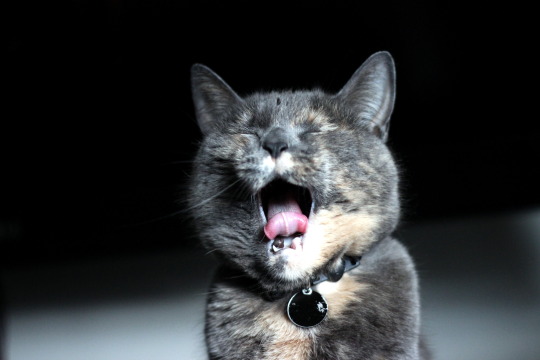
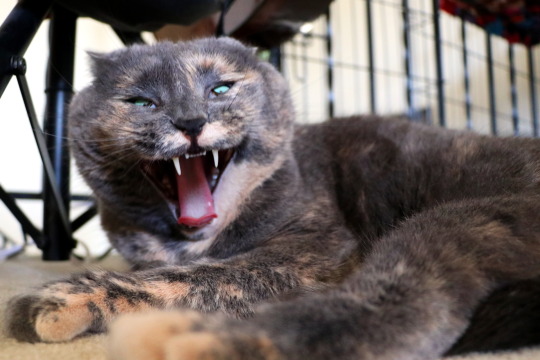
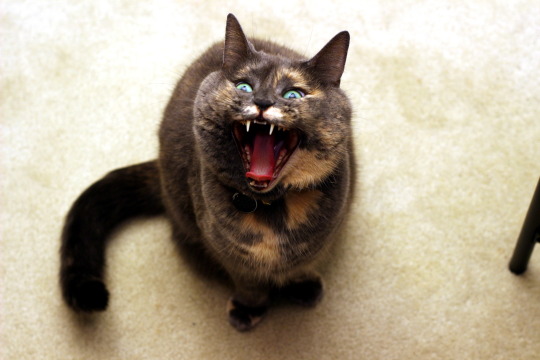
TL;DR: You can see the void when your cat yawns because it has evolved to have a) a jaw that drops down like a level arm to crush and tear food with the back teeth and b) minimal lips / cheeks that can pull back to get out of the way of getting tasty things in contact with the carnassial teeth.
You can’t do the same because you have jaw musculature that works on a much more vertical plane, your jaw hinge is positioned for a different chewing mechanism, and you have too much cheeks.
It is entirely possible there is more to the physiology of this than listed here – if so, I would love to read any sources you’ve got to throw at the blog.
On an interesting note: clouded leopards have a crazy gape angle, at close to 100 degrees – very similar to what researchers think sabertoothed cats could achieve. Lions, in contrast, can only get to around 65 degrees. Nobody is entirely sure why they have that adaptation, though.
lmao on the edinburgh zoo site it says “there is a daily penguin parade at 14:15 but it may be cancelled last minute as it is a voulntary parade, we do not coax the penguins with food, and they may not want to go out” lmao anarchopenguinism
this is the cutest goddamn thing i’ve ever heard
I saw the penguin parade. It was a very slow parade, because the
pingüinos take their sweet time and aren’t very fast walkers to begin with.
can I volunteer to be a penguin
I feel like the world needs to know the context of the edinburgh zoo penguin parade, becausr I’ve been going there my entire life and I only found out about this the other year.
So a while back (I can’t remember exactly when but I think it was some time around the 40s/50s), a bunch of penguins escaped. A keeper left the gate open so a bunch of penguins just… followed them. And the people loved it. Look at these adorable birds outside their cage just following that guy around! So they get all the penguins back inside and realise that none of them really ran off, they just followed the keeper and went back inside and crowd thought it was amazing, so why not make it a regular thing? Get enough people there that if one of them goes to make a run for it (which at least one has in the past), they can’t get past the people, and let the ones who want outside have a little wander. So every day, they get a crowd, they open the gate, and whatever penguins want to get out can go, waddle about, squawk at people, and then hop back inside.
Also, one of those penguins is Brigadier Sir Nils Olaf III, Colonel-in-cheif of the Norwegian King’s Guard. This isn’t really related to the parade at all, I just love the fact that there’s a penguin in the Norwegian army
Reblogging with Brigadier Sir Nils Olaf III inspecting his troops.
birds were invented by sticking a bunch of weapons and feathers on a ball of pure hubris and bringing it to life by the power of spite and fight alone, they are completely lacking in the ability to regret bad decisions like the ones about to be made above
I like how the second heron is just hovering in the back like GREG. GREG, NO. LETS JUST GO HOME, COME ON


 Plot Designing